
You finish a video and another starts. You close an app and a notification invites you back. A game warns that you will lose a reward unless you return today. Article 17 of the leaked Digital Fairness Act would require traders to provide effective, easily accessible tools to disable specified features, individually or together, where the product design is intended, or can reasonably be foreseen, to encourage compulsive or excessive use.1
That could give someone who wants to stop autoplay a useful control. It also leaves the consumer responsible for using it. The Commission considered switching attention-maximising features off by default for everyone and rejected that approach. I wanted to understand why, and how the evidence led to the four categories that now appear in Article 17.
The documents contain a substantial case for intervening. They offer a less complete account of how the Commission drew the legal boundaries. Consumers need controls that help them act on their preferences, while businesses and authorities need to know which designs trigger the duty.
This analysis concerns leaked working drafts, rather than an adopted law. I use the standalone proposal for article and recital references. Its numbering differs from the MLex copy in places, and its Article 17 contains an additional exclusion. All page references use the documents’ printed numbers.2
Why the Commission Chose Consumer Controls
Recital 66 supplies the most direct explanation. It describes products that capture and retain attention in ways that may harm consumers’ economic interests. It argues that some features exploit cognitive and psychological vulnerabilities for economic purposes. After discussing the DSA and the proposed EU KIDS Act, it invokes extensive evidence of harm to adults and beyond the services covered by the children’s proposal. On that basis, the recital says consumers should be able to disable features that encourage compulsive or excessive use.3
The impact assessment identifies a regulatory gap behind that argument. DSA obligations differ according to the type and size of service. Some streaming services, standalone chatbots and apps fall outside the relevant platform rules. The Commission also identifies no equivalent general entitlement under the DSA to switch off attention-maximising features. Article 17 would establish a specific consumer protection requirement across a broader range of digital products.4
The route through the impact assessment is reasonably clear. The Commission screened 61 measures, retained 51 for further assessment and grouped them into policy options. For spending- and attention-maximising features, it selected option B3. That package includes a switch-off option for all consumers and stronger measures for minors. Annex 8 describes an easy, clearly visible way to deactivate features such as autoplay, infinite scroll and engagement streaks.5
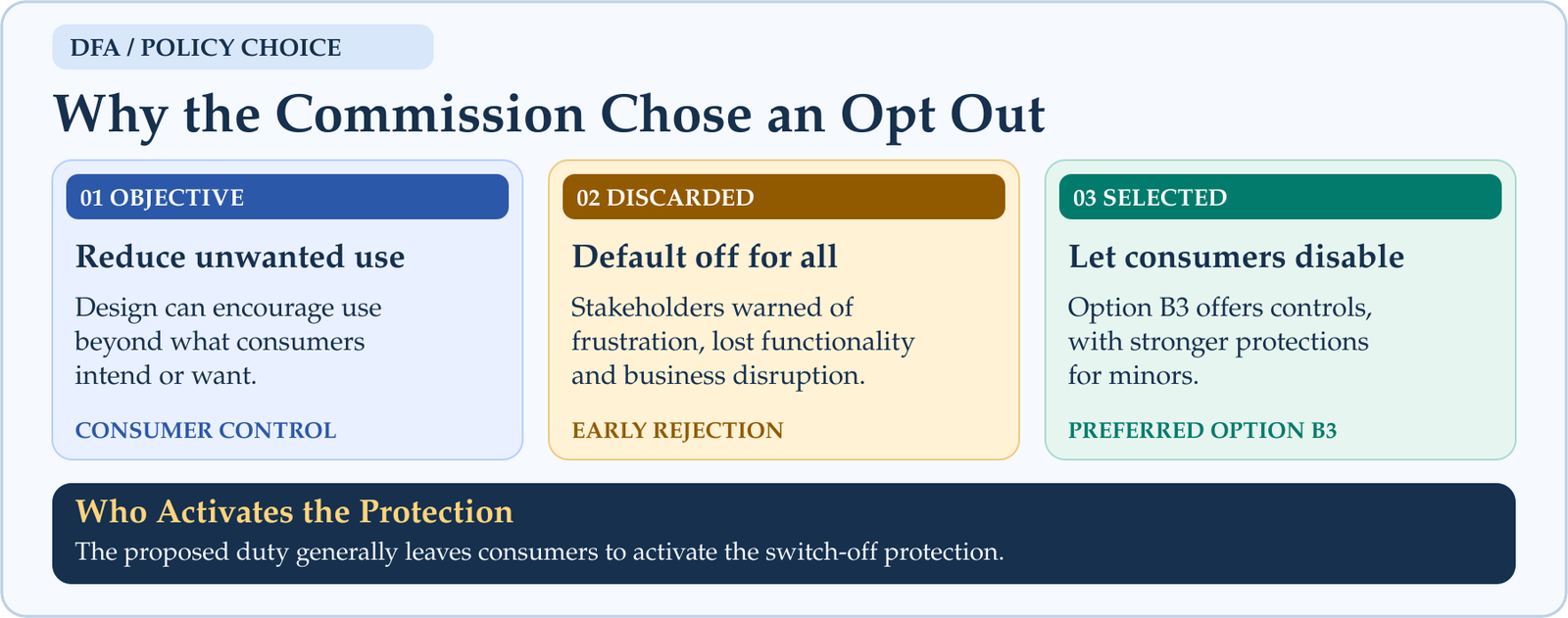
Section 5.3 explains why the Commission discarded switching these features off by default for everyone. It records 58% support among consultation respondents who favoured EU action on addictive design. It then cites stakeholder concerns that this approach could frustrate users, remove functionality they wanted and substantially affect businesses. The Commission considers the expected disruption to business models and consumer experience excessive compared with the alternatives, including a right to switch features off.6
That is an express proportionality argument. The Commission recognises that some consumers value these features and that changing defaults could disrupt how services operate. Yet the passage relies heavily on stakeholder views and predicted disruption. It does not provide a detailed comparison between the final Article 17 obligation and a carefully specified default-off alternative.
The Commission on proportionality
“the expected disruptive effect on business models and consumer experience was considered excessive”
European Commission, impact assessment, §5.3, p. 47. This passage concerns both the universal default-off measure and a separate universal spending-feature prohibition.
The scoring of B4 cannot fill that gap. B3 scored 2.75 overall, while B4 scored 2.45. But B4 bundled broader prohibitions for minors with consumer control over recommender-system parameters. The Commission marked it down on coherence and wider proportionality concerns. Those scores compare packages; they do not establish that every stronger version of Article 17 would impose excessive costs.7
What the Experiment Tells Us
The Commission has behavioural evidence for offering controls. Section 6.2.1 reports that providing an opt-out could reduce consumers’ time online by approximately 19%. Switching features off by default for minors could reduce their time online by approximately 31%. Footnote 235 also cites a Netflix experiment by Schaffner and colleagues, which found that disabling autoplay reduced viewing measures, including average daily watching and session length.8
The Netflix study gives an important comparison. In a controlled study of 76 US users, the researchers estimated 21 fewer minutes of daily viewing and 17.6 fewer minutes per session when autoplay stopped. The daily figure comes from a comparison accounting for changes in both groups against their earlier viewing; it is not a simple before-and-after fall for every participant. These are substantial effects in that setting, although the study lasted only 10–17 days. The evidence does not support a general claim that changing defaults makes little difference.9
The assessment’s own experiment needs closer attention. Annex 2 explains that researchers used a simulated food discovery app. Default settings and opt-out choices affected browsing and perceived control. However, only 8% of consumers chose to opt out of at least one engagement-maximising feature. A notification drawing attention to the option produced no statistically significant difference in uptake.10
The Commission on take-up
“Only 8% chose to opt out of at least one engagement-maximising design feature”
European Commission, impact assessment, Annex 2, §7, pp. 97–98.
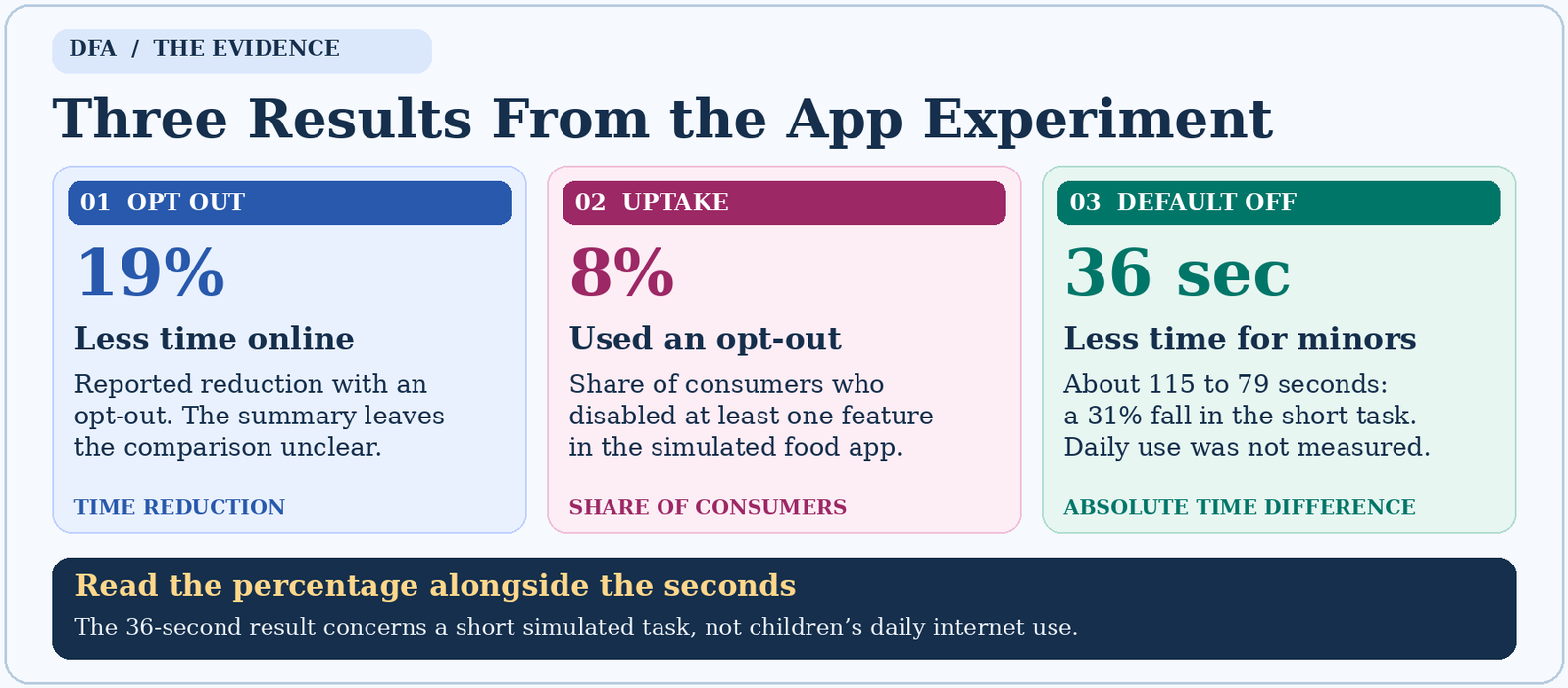
For children, the app experiment found that switching features off by default reduced browsing from roughly 115 seconds to 79 seconds. The absolute difference was about 36 seconds: from 1 minute 55 seconds to 1 minute 19 seconds in a short simulated task. Children also reported slightly greater control, rising from 3.24 to 3.45 on a five-point scale. Around 6–8% nevertheless switched the features back on when the app invited them to do so.11
The 36-second difference amounts to approximately 31% within that task. It does not establish a 31% reduction in children’s daily internet use. A short task produces a small absolute time difference even when the relative change is appreciable. The result supports an effect on browsing in the experiment; it leaves the size and persistence of any everyday benefit open.
These findings support the proposition that design changes can alter behaviour. They also expose a weakness in relying on consumers to activate protection. A service might provide a perfectly usable switch that few people use. Low uptake alone does not establish that consumers lack appetite for protection. People may prefer the original setting, overlook the choice or fail to act on an intention to change it. The consultation’s 58% support for default-off among respondents favouring EU action makes a blanket claim of consumer indifference especially difficult to sustain.
The assessment’s summary does not fully reconcile the reported 19% reduction with the 8% uptake, including whether the reduction applies across everyone offered the option or a particular comparison group. The underlying study needs to resolve that question before either figure supports a broad claim about Article 17’s effectiveness. A short experiment in a food app also cannot establish how the same controls will perform over months of streaming, gaming or conversation with an automated companion.
There is a further question about the outcome. Someone may welcome a shorter session because the app helped them stop when they intended. Another person may spend less time because the service became inconvenient. Time spent gives researchers a measurable result. Whether the design restored a consumer’s control requires further evidence about what the consumer wanted and why their behaviour changed.
How the Evidence Connects to the Four Categories
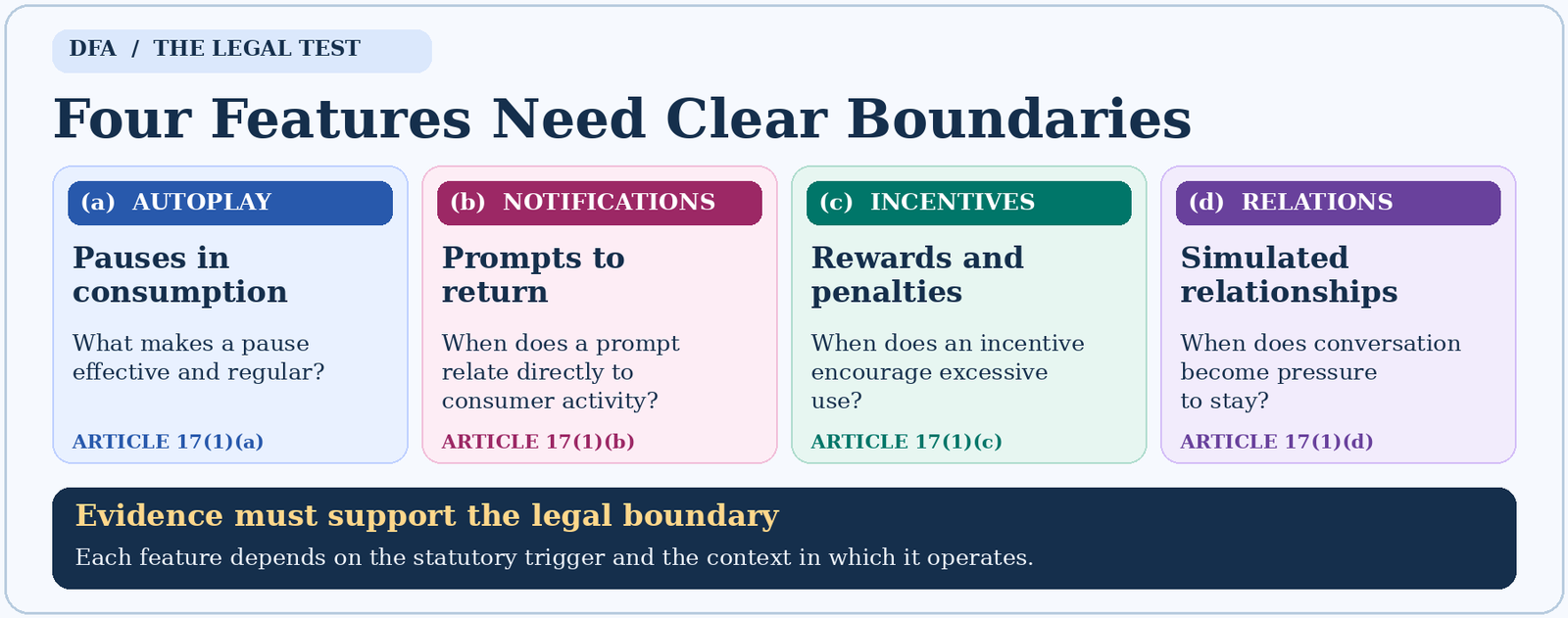
Article 17 does not simply declare every engaging feature unlawful. Its opening condition concerns a product design intended, or reasonably foreseeable, to encourage compulsive or excessive use. It then requires controls for four categories of features that encourage such use. The evidence helps explain the categories, but leaves questions about their limits.12
Autoplay and uninterrupted consumption have the clearest connection to the material. The assessment discusses autoplay and infinite scroll, identifies their prevalence and cites the Netflix experiment. Article 17(1)(a), however, turns on the absence of effective and regular interruption moments that allow the consumer to deliberate. The documents do not explain how often an interruption must occur, what makes it effective or how an authority should assess the opportunity for deliberation.13
Notifications also have clear antecedents. The assessment discusses prompts that bring people back and reproduces DSA guidance on artificial notifications and notifications timed to recapture attention. Article 17(1)(b) uses a particular boundary: notifications not triggered by, or not directly related to, the consumer’s interaction or activity. The record does not fully explain why that relationship supplies the right legal test. A notification can relate to an earlier activity and still exert pressure to return.14
Engagement incentives include rewards for regular use and penalties for disengagement. The assessment discusses streaks, reinforcement, fear of missing out and loss aversion. Those mechanisms help explain why a lost reward can influence behaviour. They do not themselves tell a court when a daily practice becomes excessive. A language learner may actively want a daily reminder and a record of progress. A game may use a threatened loss to induce unwanted return visits. Article 17(1)(c) needs an intelligible way to assess those contexts.15
Simulated interpersonal relations have a more recent research base. Footnote 33 cites work by Shen and colleagues on chatbot addiction and by De Freitas and colleagues on emotional manipulation by AI companions. The latter paper includes controlled experiments on messages that pressure users to continue after saying goodbye. Recital 66 expressly identifies simulated relationships as a way to prolong use. The Commission’s own food-app experiment does not test this category. The drafting question concerns how Article 17(1)(d) translates the external evidence into a boundary between ordinary conversational responsiveness and problematic pressure.16
The selection itself deserves an explanation. Annex 8’s description of the switch-off measure also names pull-to-refresh, ephemeral content and social-validation metrics such as likes. Article 17 does not name those features separately. Some implementations might fall within its broader wording, but the documents do not explain why the final list took this form or which omissions were deliberate.17
What the Harm Figures Can Support
The Commission’s case extends beyond mental health. Consumers report unwanted time online, unwanted spending and anxiety or guilt. The assessment estimates annual financial detriment from attention-maximising features at €2.08 billion. That figure comes from a survey-based calculation extrapolated to the EU population; it does not measure diagnosed addiction.18
For mental health, the assessment expressly acknowledges that the evidence connecting extended digital use and wellbeing is largely correlational. Much of the literature summarised in Annex 12 examines associations between use, problematic use and mental health. An association means that two things occur together. Establishing how much a particular design caused the outcome requires a different investigation.19
Annex 4 makes the limits unusually clear. To estimate avoided mental health problems, the model applies a 7% assumption to the population whose emotional harm it treats as alleviated. The model derives that assumption from an estimated excess risk associated with intensive use, then attributes roughly half of that risk to the relevant practices. The assessment acknowledges that no direct empirical evidence supports this attribution share. It says no study isolates the risk attributable specifically to these design practices from content, peer interactions or general usage.20
The Commission on its research assumption
“this 7% attribution share is not based on direct empirical evidence”
European Commission, impact assessment, Annex 4, §III.4, p. 131.
The Commission also says that these mental health estimates provide contextual information and do not enter the scoring of the policy options. It would therefore misrepresent the assessment to say that the 7% assumption determined B3’s selection. Equally, the estimates should not circulate as measured numbers of illnesses that Article 17 will prevent.21
Consumer legislation can respond to unwanted spending and impaired choice without requiring proof of a clinical disorder. Preventive rules can also operate under uncertainty. The difficulty arises when the heading “Addictive design” encourages a stronger reading of the evidence than the assessment supports. Prolonged use, regretted use, impaired control and clinical addiction describe different outcomes. The law should identify which outcome triggers which obligation.
The Scrutiny Board Asked Many of the Same Questions
The Regulatory Scrutiny Board gave the assessment a positive opinion with reservations on 3 July 2026. The account of its comments is revealing. The Board wanted clearer distinctions between dark patterns, addictive design and personalisation, a clearer account of evidence gaps and greater precision about the contexts in which practices cause harm. It also asked which behavioural experiments supported which measures.22
The Board specifically requested a better justification for excluding default-off measures from assessment. It questioned how meaningful consumer control over attention-maximising features could work without corresponding transparency requirements. A consumer cannot necessarily make a useful choice merely because the interface contains a switch.23
The scrutiny board on meaningful control
“It is not clear how meaningful control of consumers regarding attention-maximising features can be ensured without corresponding transparency requirements.”
Regulatory Scrutiny Board comments reproduced in the impact assessment, Annex 1, p. 88.
The Commission’s responses point to expanded descriptions, further evidence and revised explanations. Those additions help readers follow the preferred policy option. They still leave no complete account connecting each element of Article 17 to the evidence and alternatives considered.
The Legal Questions That Remain
The opening words of Article 17 deserve particular attention. “Compulsive or excessive” creates alternative triggers, yet the documents provide no operational definition of either term. They also give no detailed account of the intent or reasonable-foreseeability test. A trader and an authority need to know whose use triggers the duty, what makes that use excessive in context and what evidence establishes the foreseeable effect. A duty to provide controls may justify a different threshold from a prohibition, but the Commission still needs to explain the threshold it chose.24
The treatment of children also needs careful reading. The explanatory memorandum describes Article 17 in terms of consumers who are not minors. The operative provision addresses consumers generally and then excludes specified traders for practices concerning minors by reference to the EU KIDS Act. The assessment explains that certain children’s protections moved into that separate proposal, including prohibitions on specified risky services. The carve-out is therefore more specific than a blanket exclusion of everyone under 18.25
There is also a material difference between the leaked copies. The standalone proposal adds an exclusion linked to categories in Article 2(4)(c) and (e) of the EU KIDS Act. Its recital describes educational or scientific services. The MLex Article 17 lacks that additional exclusion. The assessment mentions flexibility for educational and health apps, but does not explain this precise choice of excluded services. The difference warrants checking against the next authoritative text.26
Finally, Article 17(2) would let the Commission add or modify categories through delegated acts, taking account of technological and market developments, behavioural research and enforcement experience. Recital 122 explains that power by reference to the changing nature of digital products. That allows adaptation, but makes the initial criteria for inclusion especially important. The power to update a list cannot supply the missing explanation for its present boundaries.27
What the Commission Should Explain Next
I would ask the Commission to publish an account of each category that connects the feature, the relevant context and the consumer outcome to the proposed obligation. That account should explain the omissions from Annex 8’s broader list and the precise exclusions. It should also make the underlying experiment and comparisons accessible, including the relationship between the 19% time reduction and 8% uptake.
The legislature should then test the opt-out against an outcome consumers recognise: whether they can use a service for as long as they want and stop when they choose. That requires evidence about the accessibility and use of controls, the effect of repeated prompts and the consequences of changing a setting. Counting fewer minutes online cannot answer all those questions.
Article 17 could give consumers a useful right. Its success will depend on how well the legal duty addresses the conduct that impairs their control. The Commission has explained why it prefers a switch. It still owes consumers and legislators a fuller explanation of when that switch will help, and why the rule draws its boundaries where it does.
References
- European Commission, leaked Proposal for a Digital Fairness Act, COM(2026) 1100 (standalone proposal), Article 17(1), p. 57. ↩
- Standalone proposal, Article 17, pp. 57–58, and recitals 66 and 122, pp. 29–30 and 45–46. Compare the MLex draft, Article 17, p. 56, and recitals 67 and 123, pp. 29 and 44–45. References below to the impact assessment mean the Commission Staff Working Document Impact Assessment report accompanying the proposal. ↩
- Standalone proposal, recital 66, pp. 29–30. ↩
- Impact assessment, Annex 9, attention-maximising features, pp. 176–178, especially p. 178. This paragraph reports the Commission’s account of the relationship with the DSA. ↩
- Impact assessment, §5.2, pp. 41–43; §6.2, Table 4, pp. 54–55; §7.1, Table 14, p. 77; Annex 8, pp. 163–165. ↩
- Impact assessment, §5.3, pp. 46–47. Annex 2, §2.1, p. 92, reports 877 of 1,509 respondents calling for EU action supporting opt-in rather than automatic exposure. It also reports 70% support for new binding rules among the 1,733 non-campaign respondents. ↩
- Impact assessment, §6.2.2, Table 5 and accompanying assessment, pp. 57–58. B4 also includes prohibiting all spending- and attention-maximising features for minors and control over recommender-system parameters; see Table 4, p. 54. ↩
- Impact assessment, §6.2.1, p. 55 and fn. 235, citing B. Schaffner et al., ‘An Experimental Study Of Netflix Use and the Effects of Autoplay on Watching Behaviors’ (2025). ↩
- B. Schaffner et al., ‘An Experimental Study Of Netflix Use and the Effects of Autoplay on Watching Behaviors’ (2025), Table 6 and §§3.3.3 and 4.2.1. DOI: Published article. Authors’ manuscript: Authors’ manuscript. The reported 21-minute effect adjusts for changes relative to each group’s baseline; both groups’ daily viewing increased during the study. ↩
- Impact assessment, Annex 2, §7, pp. 97–98. The programme of main consumer experiments involved 4,111 participants across five Member States; the report does not identify that number as the sample for every individual comparison. ↩
- Impact assessment, Annex 2, §8, p. 98. The minors’ experiments covered ages 12–17; the programme involved 1,574 participants across five Member States. Absolute and relative changes calculated from the rounded reported means: 115 − 79 = 36 seconds; 36 ÷ 115 × 100 ≈ 31.3%. The report gives control ratings of 3.24/5 and 3.45/5 without a significance test for that comparison in the summary. ↩
- Standalone proposal, Article 17(1), p. 57. ↩
- Standalone proposal, Article 17(1)(a), p. 57; impact assessment, pp. 16–17 and 22–24; §6.2.1, p. 55 and fn. 235; Annex 8, p. 164. ↩
- Standalone proposal, Article 17(1)(b), p. 57; impact assessment, p. 17 and Annex 9, pp. 176–177. ↩
- Standalone proposal, Article 17(1)(c), p. 57; impact assessment, pp. 16–17; Annex 8, p. 164; Annex 11, p. 188 and fns. 346–350, including M. Flayelle et al., ‘A taxonomy of technology design features that promote potentially addictive online behaviours’ (2023) and A. Monge Roffarello et al., ‘Defining and Identifying Attention Capture Deceptive Designs in Digital Interfaces’ (2023). The examples in the paragraph illustrate the distinction; they are not findings from those studies. Primary publications: Flayelle et al. and Monge Roffarello et al.. ↩
- Standalone proposal, Article 17(1)(d), p. 57, and recital 66, pp. 29–30; impact assessment, p. 17, fn. 33, citing M. K. Shen et al., ‘The AI Genie Phenomenon and Three Types of AI Chatbot Addiction: Escapist Roleplays, Pseudosocial Companions, and Epistemic Rabbit Holes’ (2026), and J. De Freitas et al., ‘Emotional Manipulation by AI Companions’ (2025). Primary papers: Shen et al. and De Freitas et al.. Shen et al. analyse self-narrated experiences in Reddit entries; De Freitas et al. combine audits with controlled experiments. The absence of a dedicated Commission experiment should not obscure that external experimental evidence. ↩
- Impact assessment, Annex 8, p. 164; compare standalone proposal, Article 17(1)(a)–(d), p. 57. ↩
- Impact assessment, §2.1.2, pp. 22–23; Annex 4, §III.1, pp. 124–125. The financial detriment model multiplies population, internet and e-commerce participation, reported exposure, reported financial impact and average monetary impact. ↩
- Impact assessment, §2.1.2, p. 23 and fns. 86–88; Annex 12, pp. 192–194. The assessment also cites longitudinal research, including the work discussed in Annex 4; the qualification concerns the largely correlational evidence base, not a claim that every cited study uses the same method. ↩
- Impact assessment, Annex 4, §III.4, pp. 130–131. The model uses Primack et al. (2021), ‘Temporal associations between social media use and depression’, to estimate an excess risk of about 13 percentage points and assumes roughly half, rounded to 7%, for the relevant attribution. Primary paper: Primack et al.. This is an observational study of US adults aged 18–30, using a depression questionnaire; it does not isolate the effect of the design features in Article 17. ↩
- Impact assessment, Annex 4, §III.4, p. 131; see also Annex 1, pp. 86 and 88, describing revisions following the Regulatory Scrutiny Board’s comments. ↩
- Impact assessment, Annex 1, pp. 85–87; standalone proposal, explanatory memorandum, p. 8. ↩
- Impact assessment, Annex 1, p. 88, and the Commission’s responses in the same table. See also §5.3, pp. 46–47. ↩
- Standalone proposal, Article 17(1), p. 57. This concerns the absence of an operational explanation in the working drafts and accompanying assessment, rather than a claim that preventive legislation must require a clinical diagnosis. ↩
- Standalone proposal, explanatory memorandum, p. 13; Article 17(1), final subparagraph, p. 57; recital 66, pp. 29–30. Impact assessment, §7.3, pp. 80–81, especially fn. 296. ↩
- Standalone proposal, Article 17(1), final subparagraph, p. 57, and recital 66, p. 30; compare MLex draft, Article 17(1), p. 56. Impact assessment, §6.2.2, p. 58, discusses flexibility for educational and health apps. ↩
- Standalone proposal, Article 17(2), p. 58, and recital 122, pp. 45–46. The equivalent recital in the MLex draft is recital 123. ↩
Originally published on LawBhoy on Substack on 12 November 2026. This article addresses the legislative texts available at that date.