
This is the third of five posts on the European Union’s proposed Digital Fairness Act (DFA). Part 2 examined what a regulator would have to prove. Here I ask which practices the law should declare unfair in all circumstances and where imprecise drafting could encourage workarounds or make useful information harder to provide. This preliminary analysis draws on the leaked European Commission working draft and annex, both marked COM(2026) 1100. The Commission describes the initiative as under preparation. MLex reporting · European Commission initiative page
A shopping app displays a badge that says someone has messaged you. The app invented the message to bring you back. A streaming service tells you that your downloads will stop working when your subscription ends. The warning accurately describes what happens. The draft gives the regulator a clear route against the first practice under point 61. Point 56 raises a harder question about the second. At what point does an accurate warning present refusal as the “wrong choice”?
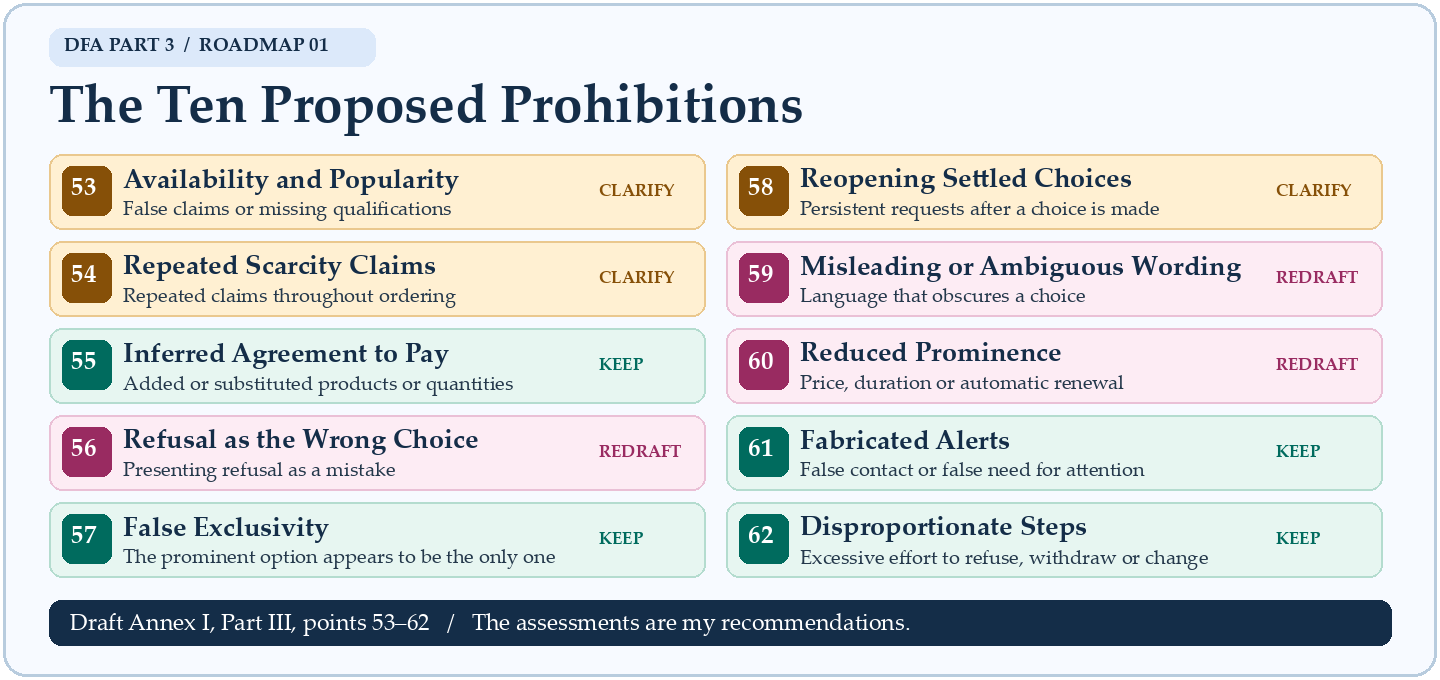
The force of Annex I is that an authority can establish unfairness by proving the elements of the entry, without a separate assessment of likely effects on a transactional decision. Recital 53 explains why the draft reserves that treatment for certain practices. Their risk of distorting consumer behaviour justifies an outright prohibition. The trouble begins when the legislature dispenses with the effects inquiry before it has defined the conduct that warrants doing so. Litigation can then move from the effect on the consumer to the meaning of a phrase such as “wrong choice”. The list has changed the dispute without making it easier to resolve. [Draft arts 5(5) and 10(2), recital 53]
Where an Outright Ban Earns Its Place
The Court of Justice illustrated the force of a listed prohibition in Purely Creative. A trader led consumers to believe they had won a prize and imposed a cost on claiming it. The Court held that point 31 of Annex I to the Unfair Commercial Practices Directive caught even a trivial cost, such as a stamp, and that offering a free route alongside a paid one could still leave the practice unfair. The point for the DFA is a drafting one. Once the legislature has specified the facts that make the conduct unfair, a court applies that definition. In that case, the amount charged supplied no escape. Purely Creative, C-428/11, paras 30–36
Point 61 is a strong candidate for that treatment. The authority can ask whether anyone actually contacted the consumer or whether an issue required their attention. Recital 122 expressly identifies fabricated alerts, badges and similar signals. A genuine delivery update still has a function. A badge that invents a message takes advantage of the expectation that a message exists. Point 57 is similarly precise where a trader falsely makes the prominent option appear to be the only available choice. [Draft Annex I points 57 and 61, recital 122]
Point 55 addresses inferred agreement to pay for an added product, a different product or a different quantity. Recital 121 places it alongside Article 22 of the Consumer Rights Directive on express agreement to extra payments and distinguishes the choice of product or quantity from authorising the underlying payment. Point 53 is persuasive on false availability and popularity claims. Its second limb also reaches the omission of relevant qualifications. Recital 120 gives the example of a scarcity claim that describes only the trader’s own supply. The useful test is whether the qualification changes what consumers reasonably understand the claim to mean. That gives the rule a boundary while preserving accurate stock information. [Draft Annex I points 53 and 55, recitals 120–121] Consumer Rights Directive, Article 22
When the Sequence Is the Practice
Point 54 reaches repeated displays throughout ordering that create an impression of scarcity. The statements can be individually accurate. It is their repetition in that sequence that can change the character of the practice. That goes beyond the existing Unfair Commercial Practices Directive’s Annex I point 7, carried over as draft point 13, which addresses false limited-time claims made to prompt an immediate decision. The gap is in the phrase “to create an impression of scarcity”. The text should make clear whether an authority must establish the purpose of the display or can assess the impression created by the ordering journey. If the answer depends on proving purpose, an otherwise observable practice may turn on what the trader recorded about its campaign. [Draft Annex I points 13 and 54] Unfair Commercial Practices Directive
Point 58 likewise targets a sequence. It would prohibit persistently asking consumers to make or change a choice they have already made, subject to what is necessary for the trader to comply with legal requirements. A fresh offer on substantially different terms may present a different decision. A trader could also change the wording, shift a prompt into email or move it into a chatbot while trying to reverse the same refusal. Article 10(1) speaks of online interfaces, while Article 5(5) gives Annex I its general effect. The draft should clarify when prompts across channels count together and what makes a choice new. Otherwise the person who receives the prompts experiences one campaign while the authority has to argue over where one interaction ends and the next begins. [Draft Annex I point 58]
Point 62 offers the best starting point for drafting that can survive changes in technology. It asks whether the steps required to refuse, withdraw or change a choice are disproportionately more numerous, complex or time-consuming than reasonably necessary. A trader can explain why account recovery calls for authentication. A regulator can ask why the same authenticated subscriber must reject three retention offers before reaching the exit. A simpler route already in use can help establish what is feasible. The law compares the actual burden with what the task reasonably requires. Reducing the dispute to click counts would miss waiting times, transfers and steps selectively imposed on particular subscribers. [Draft Annex I point 62]
Three Entries That Need a Clearer Boundary
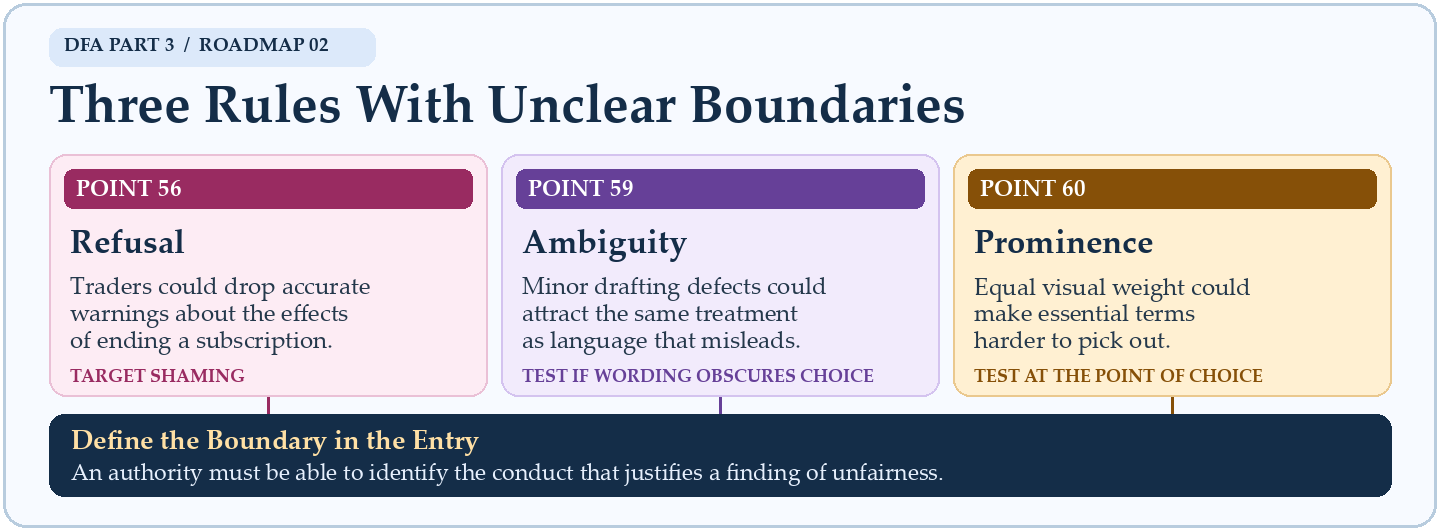
Point 56 would ban presenting refusal to buy or continue receiving a product as the wrong choice. I would distinguish a message that disparages the consumer for declining from a factual explanation of what declining will do. A trader should be able to tell a subscriber when access ends or what happens to saved material. If compliance teams read the entry as a ban on describing adverse consequences, they may remove information a consumer needs to leave on informed terms. I would confine the entry to clearly defined shaming or misleading statements about the consequences of refusal. Borderline pressure can be assessed under the general rules, including Articles 8 and 9 where the facts support an aggressive-practice case. [Draft Annex I point 56, arts 8–9]
Point 59 would cover misleading or ambiguous language in the presentation of choices, including reversals in framing and double negatives. The word ambiguous creates the risk. A clumsy translation can admit two readings without confusing most readers. An inverted prompt can make a consumer enable a paid option they thought they had refused. A per se entry should identify ambiguity that obscures what the choice does for the intended audience. If the inquiry instead requires a broader assessment of the wording, the medium and the likely effect on a transactional decision, Article 7 already supplies a route for misleading omissions. [Draft Annex I point 59, art 7(1)–(3)]
Point 60 tackles a real problem by giving price, and where applicable duration and automatic renewal, a prominence rule in invitations to purchase. Its drafting leaves the comparator uncertain. Does the price have to match the prominence of the most salient item of material information, or is the comparison with the overall presentation? A rigid parity rule could make every line compete for attention and produce disclosures that are formally prominent and hard to scan. I would ask whether the consumer can readily notice and understand the price and the relevant contract terms at the point of decision. The test should work in the medium the trader uses, including spoken offers. [Draft Annex I point 60, arts 3(8) and 10(1)]
The Case for a Shorter List With Better Evidence
Recital 51 preserves the general unfairness rules for conduct outside the list and the specific digital provisions. That gives the legislature room to choose a different tool for harder cases. Keep outright prohibitions for precisely defined conduct. Where the evidence supports an inference but the trader may have a legitimate explanation, the legislature could specify a rebuttable presumption. Repeated prompts across linked channels after a recorded refusal could, under defined conditions, support an inference of likely material distortion. The trader could rebut it by showing that the later prompt concerned a different choice. The draft would need to specify the facts that trigger the inference and what they establish. [Draft recital 51, arts 5–10 and 34]
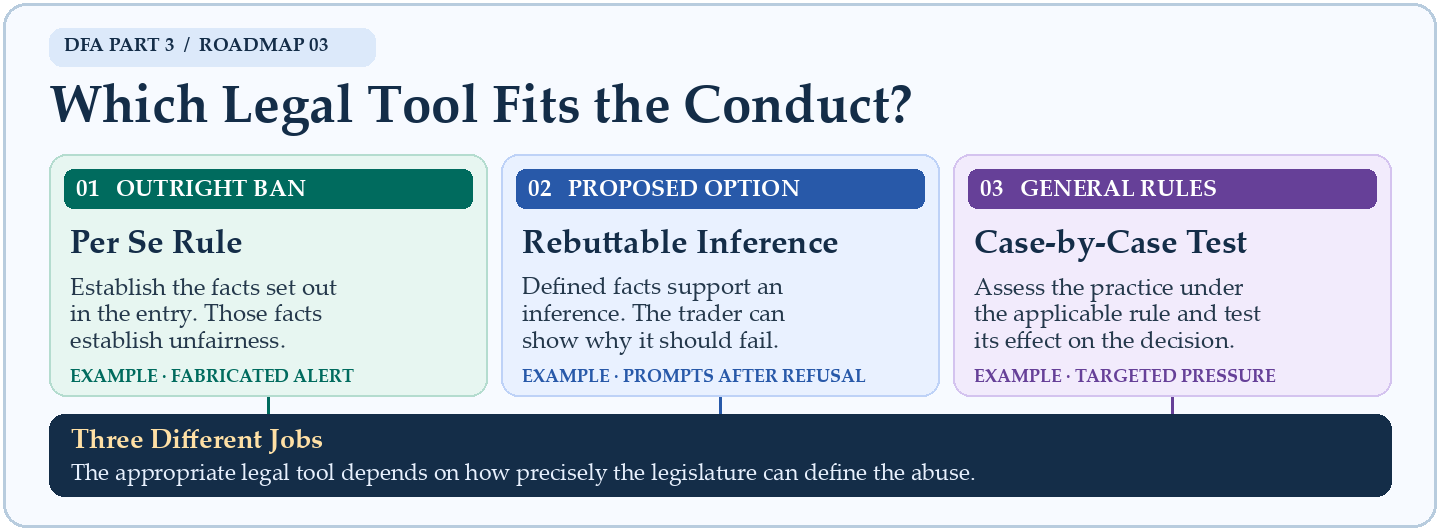
There is also a question of institutional design. Article 5(5) of the current Unfair Commercial Practices Directive reserves amendments to its blacklist to revision of the directive. Recital 123 explains why the leaked DFA takes a different route. Article 10(3) would let the Commission add or modify entries in Part III by delegated act in light of developments in markets and technology, behavioural research and enforcement experience, where necessary to maintain the level of protection. Article 37 provides for consultation with Member State experts and allows Parliament or Council to object to an act or revoke the delegation. Article 290 TFEU confines delegation to non-essential elements. The legislature should therefore settle the core criteria for an outright ban in the regulation itself. Evidence that a technique often influences consumers can justify scrutiny. Turning it into a per se prohibition requires a further judgement about whether the prohibited conduct can be defined without catching ordinary uses. [Draft arts 10(3) and 37, recital 123] Unfair Commercial Practices Directive · Article 290 TFEU
The deeper gap appears when a trader can produce the same pressure through a different mechanism. A platform could stop repeating prompts and instead learn when a particular subscriber is most susceptible to a single retention offer. Each version might look ordinary. The commercial practice lies in whom the trader selects, when it intervenes and what it learns from the response. In Part 4, I’ll look at what happens when that system becomes the object of the case, and whether Articles 10 and 34 give an authority enough to investigate and prove it.
Originally published on LawBhoy on Substack on 11 November 2026. This article addresses the legislative texts available at that date.