
This is the second of five posts on the European Union’s proposed Digital Fairness Act (DFA). The first looked at what the proposal would change for consumers. Here I take one subscription through the legal tests in the leaked European Commission working draft and its annex, both marked COM(2026) 1100. The analysis is preliminary. The Commission describes the initiative as under preparation. MLex reporting · European Commission initiative page
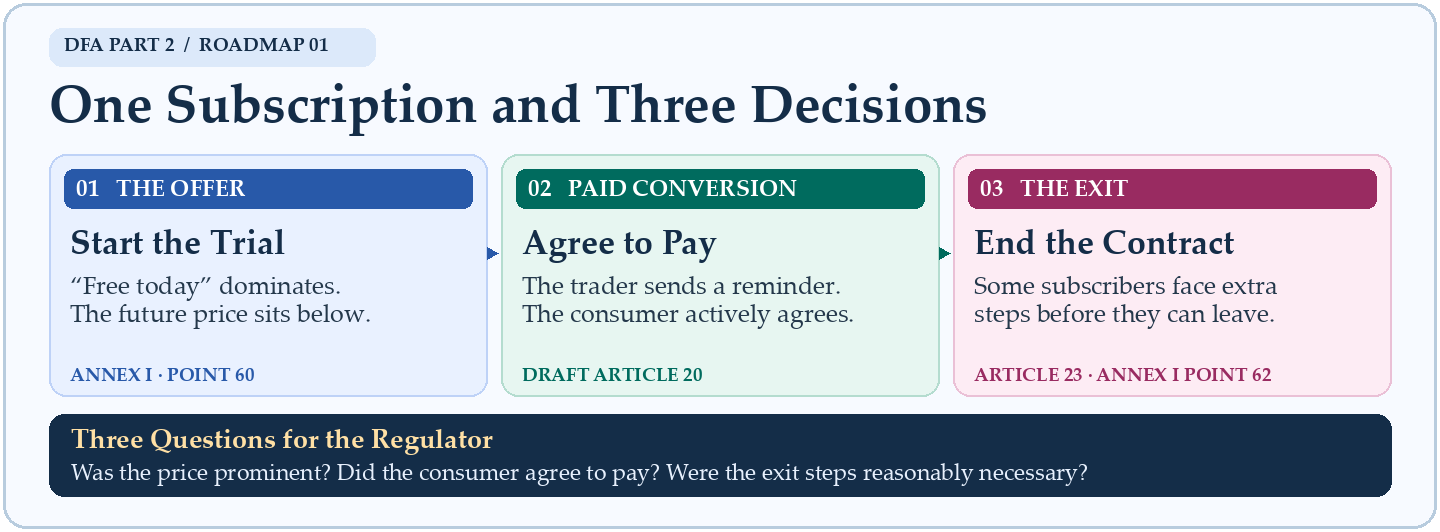
You sign up for a streaming trial. The page gives “free today” the best seat in the house. The €12.99 monthly charge sits in smaller type beneath the offer. Before the trial ends, the service sends a proper reminder and you actively choose to pay for another month. Later, when you go to cancel, the service offers a discount, suggests a pause and asks you to confirm again. A friend on the same plan reaches the final confirmation much sooner.
An authority could examine three distinct decisions. One subscriber starts a trial, agrees to pay and then tries to leave. The smaller print raises a question about prominence. The trial conversion raises a question about agreement. The cancellation route raises a question about the effort the trader can reasonably demand. Calling the entire journey a dark pattern tells us where to look. The case starts when we specify what the trader did and which choice it affected.
A subscription is a useful test because the trader has a reason to persuade at each stage, and the consumer has a reason to listen. A genuine discount may be exactly what someone wants. A confirmation step may prevent an accidental cancellation. In my work on deceptive design, I have argued for examining how the whole practice works, including how a trader assigns different routes to different people. Dark Patterns, Deceptive Design, and the Law
When the List Gives You a Direct Route
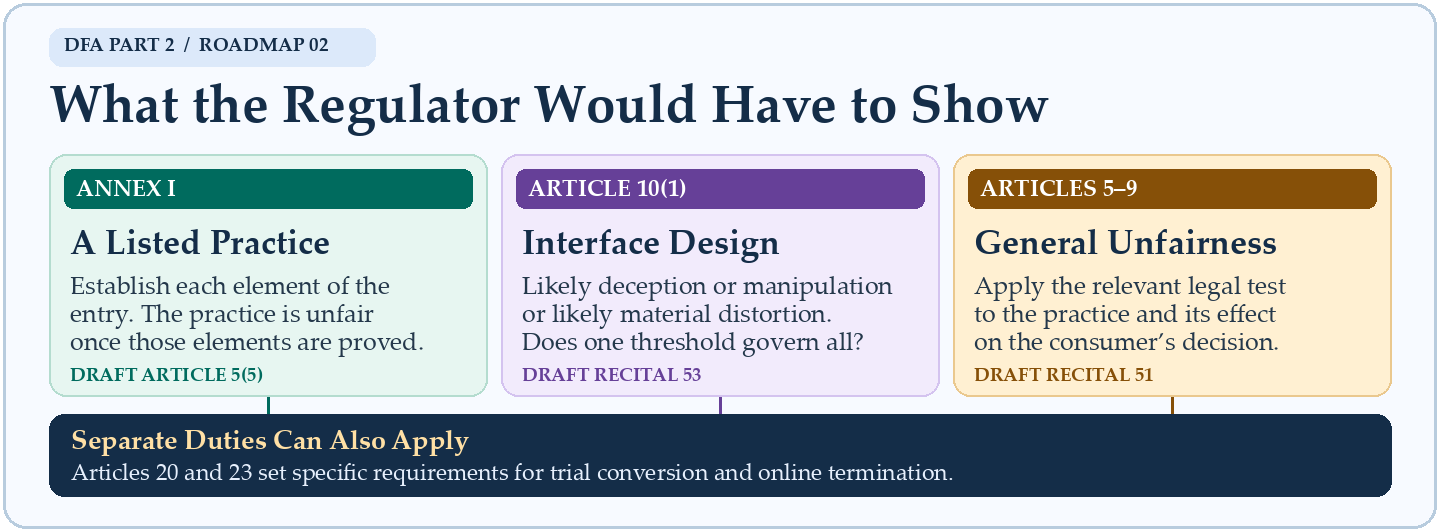
Annex I lists practices that would be unfair in all circumstances. The authority would have to establish the elements of the particular entry. Once it does, it can dispense with separate proof that the design changed, or was likely to change, a transactional decision. That is a considerable advantage where the legislature can describe the conduct with enough precision. [Draft art 5(5), art 10(2) and Annex I]
Take point 60. In an invitation to purchase, it addresses presenting the price or, where applicable, contract duration and automatic renewal with less prominence than other material information. An authority would look at the offer as presented and establish what the consumer could readily see. The fact that the €12.99 figure is accurate would leave the prominence question open. So would a properly handled trial conversion later on. The initial offer and the later decision to pay are distinct, and Article 20 sets its own requirements for a reminder and express agreement before the consumer can be bound on a paid basis. [Draft art 3(8), art 20 and Annex I point 60]
At the other end of the journey, point 62 asks whether the steps to refuse, withdraw or change a choice are disproportionately more numerous, complex or time-consuming than reasonably necessary. Apply that to the refusal and cancellation sequence. A single confirmation can serve a legitimate purpose. A series of detours needs an explanation. A shorter route that the trader offers to another group could help show which steps are necessary, especially if both groups use the same authentication. The comparison is with a reasonably necessary route. The difference in the number of screens helps test that judgement. [Draft Annex I point 62]
Article 23 gives the authority a separate line of inquiry. A trader offering online contracting would have to provide a prominent, easily accessible termination function. If account routing keeps one group away from an otherwise compliant function, Article 29’s anti-circumvention rule could also come into play. The trader can design the button perfectly and still make it hard to reach. [Draft arts 23 and 29]
What Article 10 Leaves Open
Article 10(1) would prohibit traders from designing, organising or operating their online interfaces in ways likely to deceive or manipulate consumers, or likely to “otherwise materially distort” their economic behaviour. The word otherwise is the source of the ambiguity. It can be read as making deception and manipulation ways of materially distorting behaviour. The grammar also leaves room to read likely deception or manipulation as sufficient on its own. Recital 53 describes the prohibition in terms of material distortion, which supports the first reading. [Draft art 10(1)]
The distinction is practical. On the first reading, an authority challenging the cancellation route would have to show that the design appreciably impairs informed choice and is likely to lead consumers to make a decision they would otherwise have avoided. An example would be subscribers retaining a service they had set out to cancel. On the second reading, the authority might establish the infringement by showing likely deception or manipulation without proving that additional link. On either reading, pointing to a layout the authority dislikes would leave a gap in its case. [Draft arts 3(6)–(7) and 10(1)]
I would put the material distortion threshold in the operative provision for cases outside precisely defined prohibitions. A trader can legitimately make staying attractive. The authority should be able to intervene where the way it presents or sequences that offer is likely to change the decision by appreciably impairing informed choice. If the evidence shows that risk, the authority can make the case before consumers start showing up with another month’s bill.
What the General Rules Still Cover
A regulator could also ask whether the offer was misleading. The general provisions on misleading actions and omissions capture different ways the same page can create a false impression. Under Article 6, the overall presentation can deceive even when the individual statements are accurate. Under Article 7, hiding material information or presenting it unclearly or too late can amount to a misleading omission. In either case, the authority would have to show that the conduct caused, or was likely to cause, the average consumer to take a transactional decision they would otherwise have avoided. Starting the trial is one decision to test. Agreeing to continue on a paid basis is another. [Draft arts 3(6), 6(1) and 7(1)–(2)]
If the trader uses the cancellation journey to pressure a consumer into staying, Articles 8 and 9 give the authority a different route. It would have to establish harassment, coercion or undue influence that significantly impairs, or is likely to significantly impair, the average consumer’s freedom of choice and leads, or is likely to lead, to a different transactional decision. Article 9(d) specifically directs attention to onerous or disproportionate barriers outside the contract when a consumer tries to exercise a contractual right. Recital 51 makes clear that the general rules can still apply when the practice falls outside a specific digital fairness rule or an Annex I entry. [Draft arts 8–9 and recital 51]
When the authority relies on Article 5(2), it would have to establish a failure of professional diligence and actual or likely material distortion. For a practice directed at a particular group, the provision uses the average member of that group as its benchmark. Article 5(3) also uses a group benchmark where a practice is likely to distort behaviour materially, primarily among particularly vulnerable consumers, and the trader could reasonably foresee that vulnerability. If the trader deliberately assigns a harder route to people it predicts will abandon cancellation, an average for the entire subscriber base can conceal the effect of that treatment. The authority needs to know who received the route before drawing conclusions from the numbers. [Draft art 5(2)–(3)]
Where Platform and Data Protection Rules Fit
The button that ends a subscription and the control that withdraws consent to personal data processing can sit next to each other. They exercise different rights. Where the trader relies on consent for a processing purpose, Article 7(3) of the GDPR requires withdrawal to be as easy as giving consent. The proposed Article 23 concerns termination of a contract. If the same trader obstructs both, the authority should specify which decision it is examining and which duty applies. GDPR, Article 7
Article 25(2) of the Digital Services Act excludes practices covered by the Unfair Commercial Practices Directive or the GDPR from its interface prohibition. Recital 52 of the leaked DFA describes the proposed division for business-to-consumer dark patterns, and Article 38(2) would read references to the repealed directive as references to the replacement regulation. A direct seller and a platform provider may run similar-looking screens under different obligations. [Draft arts 4 and 38(2), recital 52] Digital Services Act, Article 25 · Unfair Commercial Practices Directive
What the Records Can Show
The consumer’s screenshot may establish where the price appeared. It can rarely show who got each cancellation route, what triggered the extra steps or whether people abandoned the process after a particular prompt. Recital 86 identifies the reason for the proposed disclosure power. The trader may be the only party with evidence of how a personalised practice works. In covered proceedings, Article 34 would let courts or authorities require necessary and proportionate disclosure if a claimant presents facts and evidence sufficient to support the likelihood of an unfair practice, or the administrative authority reasonably suspects one. The authority would still apply the elements of the chosen rule. [Draft art 34 and recital 86]
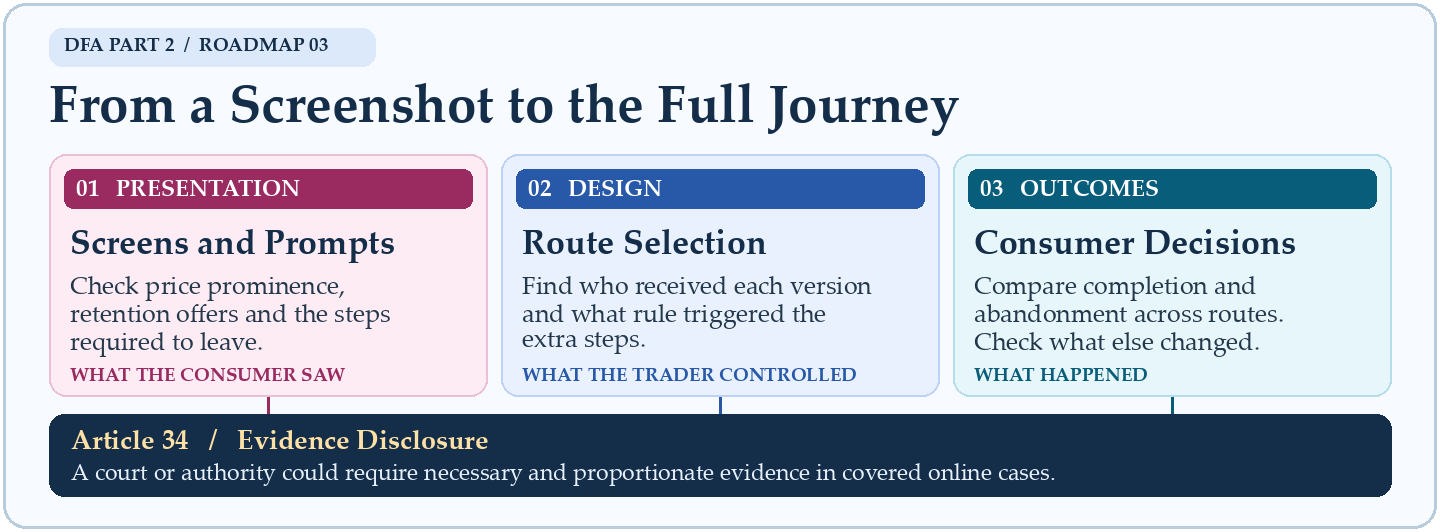
I would ask for the versions consumers saw, the rules that assigned them and completion rates for each route. If a shorter route serves the same function, that comparison could help establish whether the extra steps were reasonably necessary. If cancellation fell after the trader introduced a new prompt, the regulator would need to check what else changed before attributing the drop to that prompt. Those are distinct uses of the same evidence. One tests the burden imposed. The other helps explain the decision the consumer made.
In Part 3, I’ll turn to the ten practices the draft would prohibit in all circumstances. A fabricated message badge gives the authority a concrete fact to check. Telling a consumer they are making the “wrong choice” calls for a different kind of judgement. I’ll ask which entries are precise enough for an outright ban and where a case-by-case test would do a better job.
Originally published on LawBhoy on Substack on 10 November 2026. This article addresses the legislative texts available at that date.