
This is the fourth of five posts on the EU’s proposed Digital Fairness Act (DFA). Part 3 examined which practices deserve an outright ban. Here I ask how an authority would investigate a service that gives different consumers different ways out, and what would justify a finding of unfairness. The analysis is preliminary and draws on the leaked European Commission working draft and annex, both marked COM(2026) 1100.1
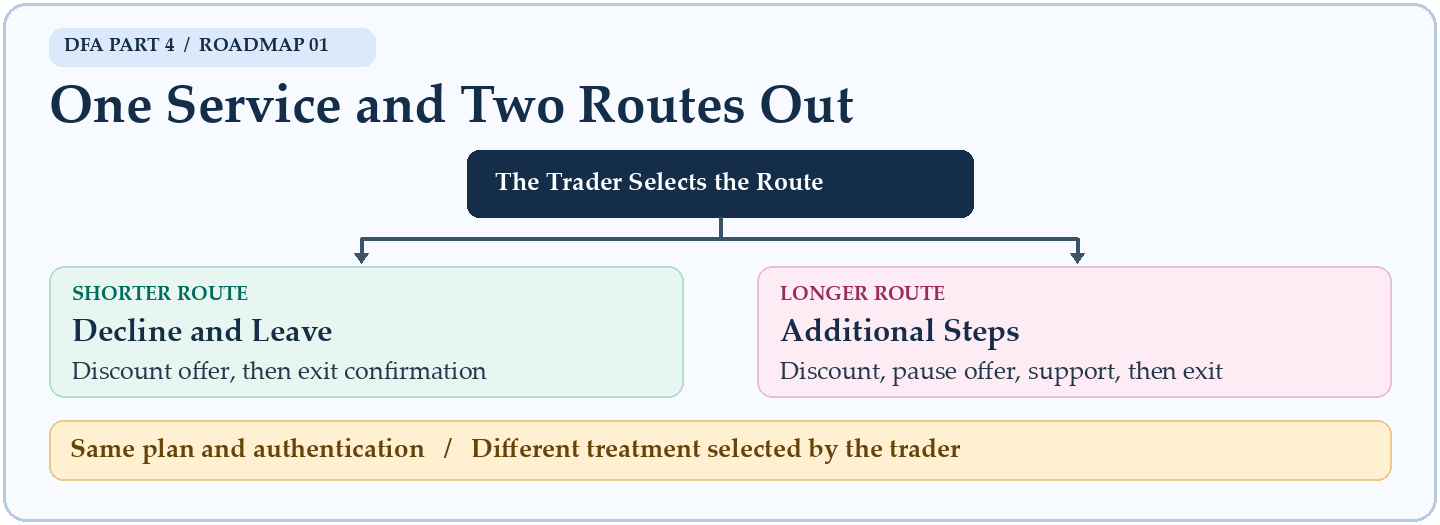
Two subscribers try to cancel the same streaming service. One sees a genuine discount and can decline it and leave. The other sees the same discount, then a pause offer, then a transfer to support. Both have authenticated in the same way. Suppose the trader assigns the longer route because it predicts that this subscriber will abandon the attempt. The individual messages could all be accurate. The question is what the trader achieved by deciding who received them, in what order and at which point in the journey.
I used a version of this example at the European Economic and Social Committee’s expert hearing on the DFA.2 The consumer sees one route. The trader can see the alternatives it tested, which people received them and how it defined success. It may count a subscriber who gives up as a subscriber it has retained. An authority that can reconstruct the whole practice can ask a question the trader’s dashboard may leave unanswered. Did the consumer decide to stay, or did they simply stop trying to leave?
What the Interface Rule Can Reach
Article 10(1) is capable of a broad reading. Its verbs are “design, organise or operate”. A rule that decides which cancellation route a consumer sees is part of how the trader operates the interface. Article 3(3) also recognises a course of conduct as a commercial practice.3 That supports looking at the sequence and the rule that assigned it together. The uncertainty grows when the trader divides the intervention between an app, a message sent later and a support queue. Article 10 attaches its prohibition to the online interface. The draft leaves room to dispute how far it reaches when the commercial practice spans several points of contact.
There are clearer routes on some facts. Article 23 requires a prominent and easily accessible online termination function where the trader offers online contracting. Annex I point 62 tests whether the steps to refuse, withdraw or change a choice are disproportionately burdensome relative to what is reasonably necessary. Article 29 could reach technical routing that undermines effective compliance with a Chapter III obligation.4 A proper case should start there if consumers cannot readily reach the exit. The difficult Article 10 case is a trader that keeps the exit accessible while selecting the moment and sequence most likely to derail a decision to use it.
Recital 53 explains that the prohibition targets the use of dark patterns to materially distort consumers’ economic behaviour.5 The wording of Article 10(1) leaves open whether likely deception or manipulation can establish a breach on its own. If material distortion governs the case, Article 3(7) asks whether the practice appreciably impairs the ability to make an informed decision and changes the transactional decision the consumer would otherwise make. The authority can look at likely effects.6 A trader’s retention objective can help explain the practice, and a finding still depends on what the design is likely to do to the consumer’s decision.
Which Consumers Supply the Benchmark
Article 5(2) assesses a practice directed at a particular group by reference to its average member.7 If a trader assigns a particular cancellation flow to consumers selected by an abandonment score, I would ask whether that allocation constitutes targeting of a group. The trader might argue that the score changes continuously and produces individual decisions. The authority should examine whether a common rule assigns a recognisable set of consumers to a particular treatment. A service-wide completion rate could conceal the experience of that group. Article 10(1) would benefit from saying expressly how the benchmark applies to a dynamically selected audience.
Article 5(3) asks a different question. It addresses practices likely to distort behaviour materially, primarily among particularly vulnerable consumers, where the trader could reasonably foresee that vulnerability. Recital 27 identifies financial distress and bereavement as personal circumstances that may make a consumer particularly susceptible, regardless of their duration.8 A score that predicts cancellation abandonment establishes a prediction about behaviour. The authority would need evidence about the circumstances, their relevance to the particular practice and foreseeability before applying the vulnerability benchmark. In Compass Banca, the Court of Justice accepted that the ordinary average-consumer standard can accommodate constraints such as cognitive biases.9 That leaves room to take behavioural evidence seriously without treating everyone who responds to a prompt as particularly vulnerable.
What the Evidence Can Prove
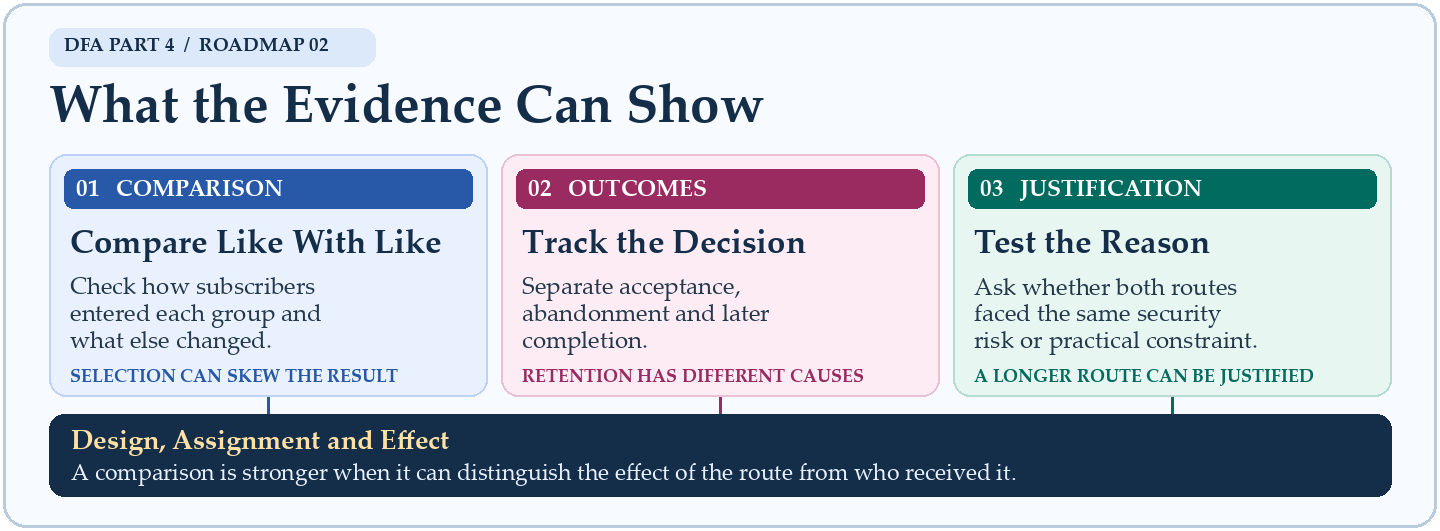
Suppose the trader’s records show that fewer subscribers completed cancellation through the longer route. That result could reflect the route or the people selected for it. Subscribers assigned extra steps may already have been more willing to consider an offer, or they may have opened the flow on devices that handle it poorly. A useful comparison would examine similarly situated subscribers who received different routes. A contemporaneous randomised comparison, where one exists, can help separate the effect of the design from the effect of assignment. If the trader changed the discount and the sequence together, the comparison may establish the effect of the package while leaving the effect of each element open.
The outcome also needs a defensible definition. Accepting a genuine discount can be an informed choice. Closing the app while waiting for support, then returning the next morning to cancel, is evidence of a different experience. The investigator should separate affirmative acceptance, abandonment and later completion. The trader may also have a good reason for a step, such as account security. The authority can test that explanation against the rule that triggered the check, whether the shorter route dealt with the same risk, and how much effort the check imposed.
An authority rarely gets the experiment it would have designed. It can put timed test journeys alongside complaint records and compare what happened before and after a change. That evidence carries more weight if the price, audience and technical performance stayed comparable. An initial disclosure request should seek enough to distinguish plausible explanations before the authority asks for a full account of the trader’s model.
The Same Problem With Engagement Controls
Article 17 would require traders to offer consumers effective, easily accessible tools to disable specified features individually or together where the design is intended, or can reasonably be foreseen, to encourage compulsive or excessive use.10 That can help someone who wants to switch off autoplay. The harder case is a trader that changes the timing of recommendations or the order of content while retaining the same engagement objective. A feature control may leave that other mechanism intact. An authority would have to identify a feature or behaviour in scope and establish the statutory trigger. Time spent using a service can reflect enjoyment, convenience or impaired control. A remedy should follow the conduct that the evidence supports. For practices concerning minors, the leaked DFA carves out traders by reference to Articles 9, 14 and 15 of the separately published EU KIDS Act proposal.11
What Article 34 Can Recover
Recital 86 recognises that a trader may hold the only evidence of how a personalised practice operates.12 Article 34 would allow a court or administrative authority to order necessary and proportionate disclosure in proceedings under Articles 30 or 32. A claimant could request disclosure after presenting facts and evidence sufficient to support the likelihood of an unfair online practice. The provision also applies where the relevant administrative authority reasonably suspects such a practice. Article 34(5) would allow a failure to disclose to count alongside other evidence in assessing unfairness.13 The practical difficulty is sharpest in a claimant-led case. A person can document what they saw and still struggle to show that a trader routed others differently.
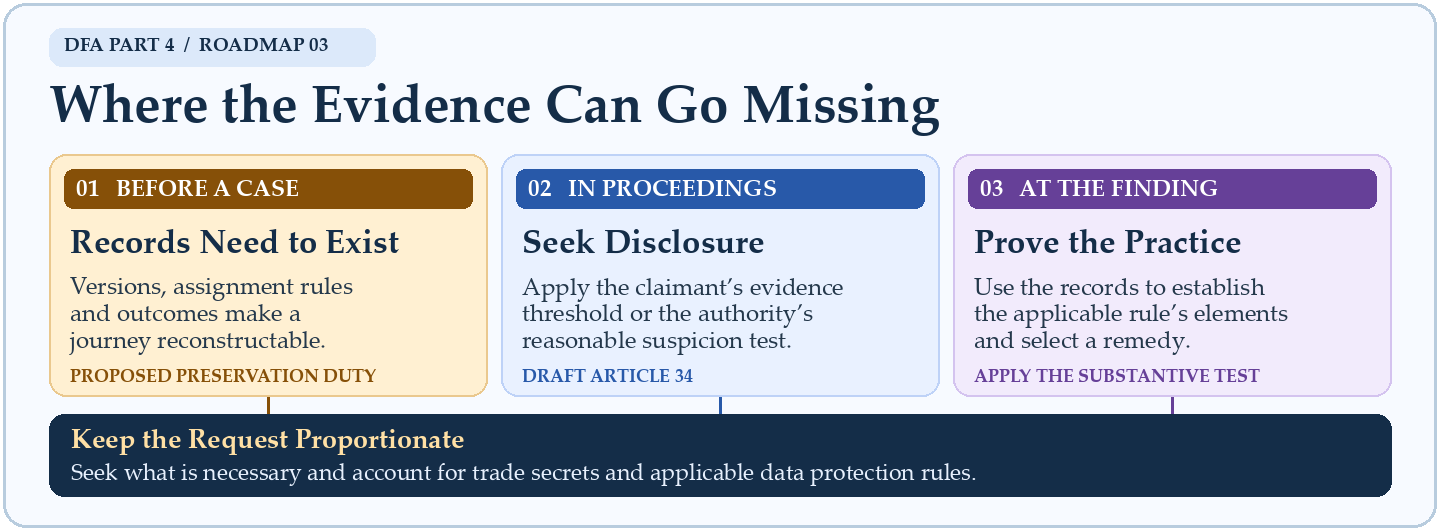
The draft gives an authority a way to request evidence. It leaves open whether the trader will have retained the versions, assignment criteria and outcome data that would let anyone reconstruct the practice. The Digital Services Act offers a limited comparison. Article 34(3) requires very large online platforms and very large online search engines to retain documents supporting their systemic risk assessments for at least three years after carrying them out.14 That duty illustrates the difference between requiring records to exist and obtaining them in a case.
A duty under the DFA should be narrower than a requirement to log every interaction. For a consequential adaptive practice, I would start with the versions deployed, the rules used to assign them and aggregate outcomes by route. If personal data are necessary for a specific investigation, the authority can justify the request and limit its scope. Article 34(2) and (3) already require necessity, proportionality and consideration of interests including trade secrets.15 Any preservation requirement should also account for the GDPR’s data minimisation and storage limitation principles.16
Part 5 will put that argument into drafting terms. I’ll propose a way to bring the assignment and sequencing of consumer journeys expressly within Article 10, pair Article 34 with a proportionate duty to keep evidence, and revisit the Annex I entries I marked for clarification or redrafting. The cancellation example will give those proposals a practical test. Could an authority reconstruct the route a consumer received, establish what it did to their choice and direct a remedy at the part of the practice that caused the problem?
References
- European Commission, leaked Digital Fairness Act working draft and annex, COM(2026) 1100, cover pages. European Commission initiative page · MLex reporting, 9 November 2026 ↩
- My intervention at the EESC expert hearing on the Digital Fairness Act, Brussels, 9 September 2026. See also Mark Leiser, Dark Patterns, Deceptive Design, and the Law (Hart 2025). Hearing presentation · Book ↩
- Leaked DFA, arts 3(3) and (11), pp 46–47, and 10(1), p 53. ↩
- Leaked DFA, art 23(1)–(2), p 59, and art 29, p 63. Annex I, Part III, point 62, p 5. ↩
- Leaked DFA, recital 53, pp 24–25. ↩
- Leaked DFA, art 3(6)–(7), pp 46–47, and art 10(1), p 53. ↩
- Leaked DFA, art 5(2)(b), p 50. See also recital 26, p 19. ↩
- Leaked DFA, art 5(3), p 50, and recital 27, pp 19–20. ↩
- Case C‑646/22, Compass Banca, EU:C:2024:957, operative part, point 1. Judgment ↩
- Leaked DFA, art 17(1), first subparagraph and points (a)–(d), p 56. ↩
- Leaked DFA, art 17(1), final subparagraph, p 56. European Commission, EU KIDS Act proposal, COM(2026) 681 final, arts 9, 14 and 15. EU KIDS Act proposal ↩
- Leaked DFA, recital 86, pp 34–35. ↩
- Leaked DFA, arts 30, pp 63–65, and 32, p 65, and art 34(1)–(3) and (5), p 66. ↩
- Regulation (EU) 2022/2065 (Digital Services Act), art 34(3). Digital Services Act ↩
- Leaked DFA, art 34(2)–(3), p 66. ↩
- Regulation (EU) 2016/679 (GDPR), art 5(1)(c) and (e). GDPR ↩
Originally published on LawBhoy on Substack on 12 November 2026. This article addresses the legislative texts available at that date.