
This is the first of five posts on the European Union’s proposed Digital Fairness Act (DFA). The Act would replace the Unfair Commercial Practices Directive with a directly applicable regulation and introduce specific rules for how traders present prices, design online choices and manage subscriptions. This preliminary analysis draws on a leaked European Commission working draft and its accompanying annex, both marked COM(2026) 1100. The Commission describes the initiative as under preparation. MLex reporting · European Commission initiative page
A streaming service offers you a month free. The sign-up page makes a great deal of the zero and rather less of the monthly charge. You give it a card, watch the programme you came for and forget about the trial. A month later, you notice the charge. To leave, you have to reject a discount, decline a pause and find the button that actually ends the subscription. It took a minute to join. Leaving, apparently, requires a conversation.
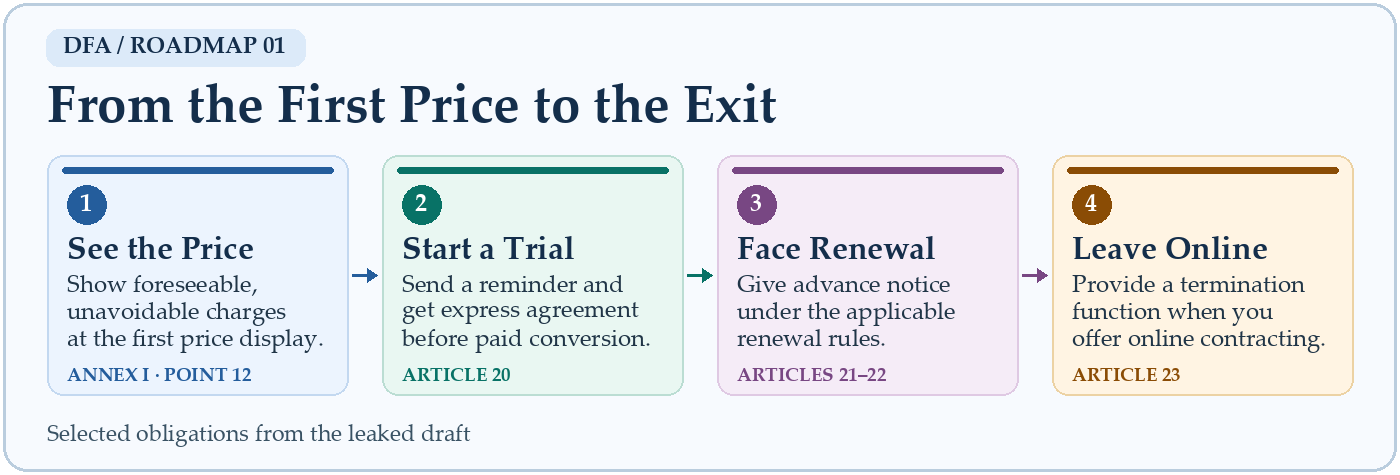
Under the leaked Digital Fairness Act, the trader would have to remind you before the trial ended and obtain your express agreement before you became bound on a paid basis. If it offers online contracting, it would have to give you a prominent, easily accessible way to terminate online. And where it makes the steps to refuse or withdraw a choice disproportionately burdensome, the draft blacklist could give an authority a direct way to challenge the obstruction. For all the attention paid to autoplay and addictive design, the provisions that may make the most immediate difference are the ones that deal with decisions people already know they want to make. [Draft arts 20 and 23, Annex I point 62]
In my work on deceptive design, I have argued that the legal inquiry should follow the commercial practice that creates the consumer’s choices. There is plenty to like here. The free-trial rule protects the decision to start paying. The termination provision makes the ability to leave more concrete. Several blacklist entries address how steps accumulate across a journey. The evidence power recognises that the firm will often know much more about the operation of the practice than the consumer who encounters it. Dark Patterns, Deceptive Design, and the Law
A New Home for EU Unfair Trading Law
The biggest change is easy to miss in a debate about buttons and notifications. The draft would repeal the Unfair Commercial Practices Directive, the general EU law on unfair business-to-consumer commercial practices, and replace it with a directly applicable regulation. The replacement would cover commercial practices before, during and after a transaction, in shops as well as online. It carries forward the familiar rules on misleading actions, misleading omissions and aggressive practices, alongside a general test of professional diligence and material distortion of consumers’ economic behaviour. [Draft arts 1–9 and 38] Unfair Commercial Practices Directive
The draft also reaches traders selling through their own websites. The Digital Services Act’s rule for online platform interfaces excludes practices covered by the Unfair Commercial Practices Directive or the GDPR. The DFA would give consumer authorities an express interface rule for traders while preserving more specific Union rules. [Draft arts 4 and 10] Digital Services Act, Article 25
A false claim about limited availability can work in a shop window, on a product page or in the voice of a shopping assistant. What changes online is the trader’s capacity to decide which person hears the claim, at what moment, and what comes next. A trader can test six ways to retain a subscriber before breakfast and deploy the most effective route to a particular group by lunchtime. The law should be able to follow that practice across the journey. A rule that depends on identifying a familiar button will struggle when the button disappears and the pressure moves into a conversation.
The proposal also gives a wider set of consumer decisions explicit recognition. Its definition of a transactional decision includes whether to continue using a product. Recital 21 gives continued scrolling as an example of a decision that can qualify when it is directly linked to a purchase or similar transactional decision. A retailer that keeps a shopper scrolling through successive offers may be shaping a commercial decision. Time spent following the football scores tells us very little, on its own, about whether anyone has interfered with a consumer’s choice. [Draft art 3(6), recital 21]
What Would Change from the Offer to the Exit
The Price You See. Annex I would require a trader to include foreseeable and unavoidable charges when it first gives the consumer pricing information. A compulsory booking fee belongs in the displayed price. An optional extra presents a different question. If an advertised event ticket price could rise through the trader’s actions or automation, the draft would require disclosure of the number of tickets in that category available at the advertised price and the maximum price. In a virtual queue, the trader would have to display the current price, whether it can change while you wait and, if it can, the maximum. A queue can tell you when you might get to buy a ticket. With a maximum price on screen, you can also decide whether the wait is worth it. [Draft arts 18–19, Annex I point 12]
The Terms on Which You Stay. The trial rule makes paid continuation a separate decision. The reminder would have to state when the trial ends and give the price, duration and termination conditions of the paid contract. The draft also sets different reminder rules for longer and shorter contracts that renew automatically. A consumer can understand a deal perfectly well on Monday and still reasonably expect notice of a renewal charge months later. [Draft arts 20–22]
The Way Out. Where a trader offers online contracting, the draft would require an online termination function even for a customer who originally signed up another way. It would also require acknowledgement on a durable medium, including the date when termination takes effect. Article 24 separately addresses statutory withdrawal from covered online distance contracts, building on the withdrawal function already in the Consumer Rights Directive. And where the trader offers online customer service after the contract starts, the consumer could ask to communicate with a human, subject to the draft’s investment-services exception. [Draft arts 23–25] Consumer Rights Directive, Article 11a
Rules for Ads and Digital Products
The digital chapter regulates several practices that tend to get bundled together in public debate. It would standardise how influencers identify paid commercial communications and restrict specified forms of profiling-based advertising and pricing. The conditions differ. For example, the proposed pricing rule concerns profiling-based personalisation reasonably likely to cause harm where the trader knows with reasonable certainty that the consumer is a minor or vulnerable. A personalised recommendation, a targeted advertisement and a personalised price can all come from the same system. The draft gives each a different legal question. [Draft arts 11–13]
For games and other digital products, the draft would require monetary values for purchases made with paid-for virtual currency, subject to specified exceptions, and introduce restrictions on paid random rewards and certain spending mechanics for minors. Its provision headed “Addictive design” generally takes the form of a duty to provide effective controls. Where a product’s design is intended or can reasonably be foreseen to encourage compulsive or excessive use, the trader would have to let consumers disable specified features that encourage such use. The features include autoplay and uninterrupted consumption without effective breaks, certain notifications and system behaviour that simulates a personal relationship. The text also carves out some practices concerning minors by reference to a separate proposed EU KIDS Act. [Draft arts 14–17]
The automated contracting provisions deserve attention in their own right. An assistant that recommends a deal influences a decision. An assistant that accepts the deal on your behalf can bind you. The draft would require consumers to choose how much confirmation they want when they first use a system covered by Article 26. It would also require confirmation of a proposed contract where the assistant’s provider receives payment for proposing it or has a relevant conflict of interest. That is a useful distinction between giving an assistant authority and allowing the firm behind it to profit from the direction in which it steers you. [Draft arts 26–27]
Three Ways to Assess Unfairness and One Way to Obtain Evidence
Article 10 would prohibit traders from designing, organising or operating online interfaces in ways likely to deceive or manipulate consumers, or likely to otherwise materially distort their economic behaviour. Its express reference to visual, auditory and other components makes it relevant beyond the conventional web page. Recital 53 frames the prohibition in terms of material distortion. Does Article 10(1) carry that threshold across the whole provision, or could likely deception or manipulation establish a breach on its own? [Draft art 10(1), recital 53]
Annex I sets out practices that would be unfair in all circumstances once the authority establishes the elements of the entry. Its ten dark patterns include fabricated notifications, false exclusivity, repeated requests to revisit a choice and disproportionate friction when a consumer tries to refuse, withdraw or change a decision. The wider list also contains familiar unfair practices, including false limited-time claims carried over from current law. Some entries describe facts a regulator can check. Others call for judgement about persistence, prominence or proportionality. The general consumer-law tests remain available for commercial conduct beyond the list. [Draft arts 5 and 10, Annex I] Unfair Commercial Practices Directive
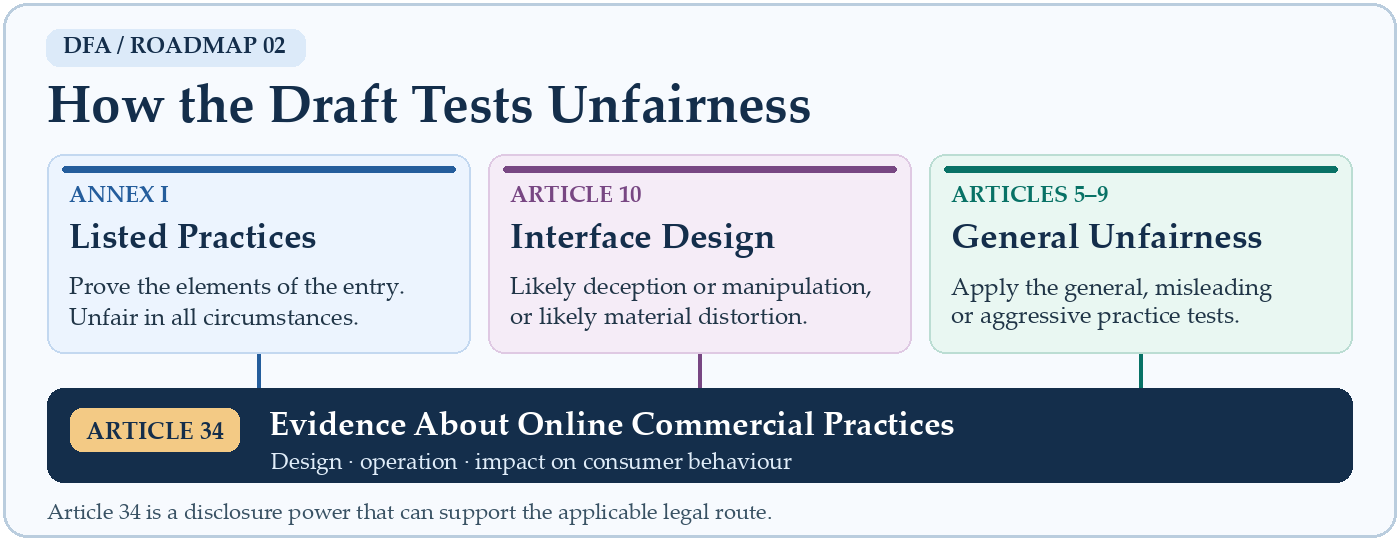
Article 34 may ultimately do more for enforcement than any new label. In proceedings covered by the draft, an administrative authority with reasonable suspicion of unfairness could require necessary and proportionate evidence about the design, operation and impact of an online commercial practice. A claimant could also ask the court or authority to order disclosure after presenting facts and evidence sufficient to support the likelihood of an unfair practice. The screenshot the consumer kept might show a grey button. The trader’s records might show that it deliberately varied the route, which group got the extra steps and how often people abandoned the attempt. The draft supplies a way to seek those records. Whether firms will have kept enough to reconstruct what happened is a separate question. [Draft arts 33–34, recital 86]
One way to judge these provisions is to ask whether consumers can tell when a choice has taken effect. If I agree to pay after a trial, I should know the price and when the first charge will come. If I end a contract, I should know when the charges stop. The draft is clearest where it turns those expectations into duties a regulator can check. The same precision should guide the rules that govern how traders personalise a journey.
The harder test is a trader that shows each consumer a superficially reasonable interface while using different sequences for different people. Consider a subscriber who receives two additional retention offers because the trader predicts that she will give up before reaching the exit. The questions are what the system selected, whether the extra steps were justified and what they did to her ability to leave. A well-designed recommendation can help someone choose. An adaptive obstacle can frustrate a decision already made. Consumer law should be able to distinguish the two on evidence about the practice itself.
Post 2 follows one subscription from the free-trial offer to the cancellation screen. The trader gives ‘free today’ more prominence than the future price, then sends some subscribers through extra steps when they try to leave. Could the regulator use Annex I to challenge either practice directly? If it proceeds under Article 10, does likely deception suffice, or must it show that the design was likely to change the consumer’s decision? The same subscription produces different cases depending on which provision the regulator invokes. I’ll trace what each route requires and when a regulator would rely on the general unfairness rules.
Originally published on LawBhoy on Substack on 10 November 2026. This article addresses the legislative texts available at that date.