
This final post in my five-part series proposes changes to the EU’s Digital Fairness Act (DFA), the proposed regulation that would replace the Unfair Commercial Practices Directive. This preliminary analysis draws on leaked Commission documents. The main text examined here differs from the version used earlier in the series, including in its recital numbering. The recommendations below are mine.1
My starting point follows the argument developed in my book, Dark Patterns, Deceptive Design, and the Law, and in my contributions to the Commission, the DRCF and the EESC.2 Consumer law must examine the commercial practice across the journey. Authorities need evidence of how traders select and sequence personalised treatment. A screenshot rarely explains why that consumer received it.
The draft offers useful protections on trial conversion and termination.3 I would preserve those gains while amending Article 10, calibrating Annex I, adding a preservation duty alongside Article 34 and making cooperation operational. The Part 4 example supplies the test: can an authority establish why one authenticated subscriber leaves immediately while another encounters repeated offers and a support transfer?
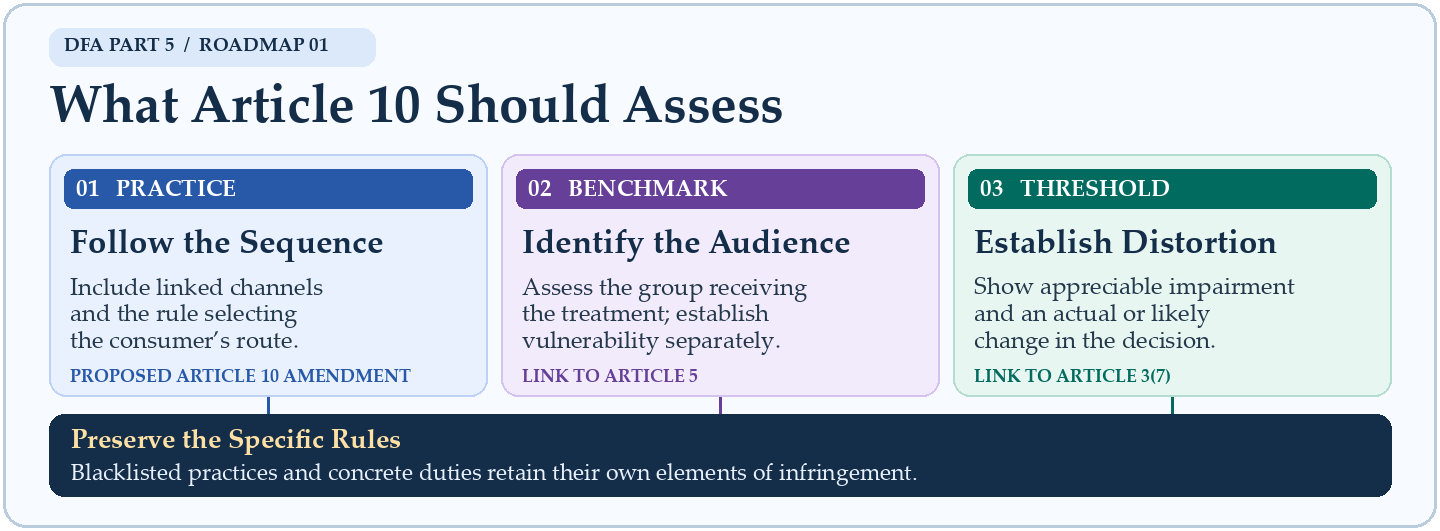
Make Article 10 Follow the Commercial Practice
Article 10(1) already prohibits traders from designing, organising or operating interfaces in specified ways. That can reach allocation logic. Article 3(3) also recognises a course of conduct as a commercial practice. The amendment should remove doubt about linked interventions across channels and make the materiality threshold explicit. Recital 52 supplies that rationale in this version; Article 10’s separate references to deception, manipulation and otherwise materially distorting behaviour leave its operative reach less certain.4
I would replace Article 10(1) with:
Traders shall not design, organise or operate a commercial practice in the online environment, including linked interactions across interfaces and communication channels and the selection, timing or sequencing of those interactions, in a manner that materially distorts or is likely materially to distort consumers’ economic behaviour. The assessment shall apply Article 3(7) and the consumer benchmarks in Article 5(2)(b) and (3). This paragraph is without prejudice to paragraph 2 and other specific obligations of this Regulation.
That final sentence preserves the blacklist and concrete duties. Breaching a precisely defined termination obligation should not require fresh proof of distortion. For the general Article 10 case, the authority should establish impairment and its actual or likely effect on a transactional decision. It need not wait for completed harm.
The benchmark should expressly include a group selected through a common behavioural inference, even where membership changes. Predicting abandonment does not itself establish particular vulnerability. The authority must still satisfy Article 5(3)’s conditions before using that benchmark. This distinction prevents a trader from hiding concentrated effects inside a service-wide average without turning every response to persuasion into evidence of vulnerability.5
Give Each Annex Entry a Defensible Boundary
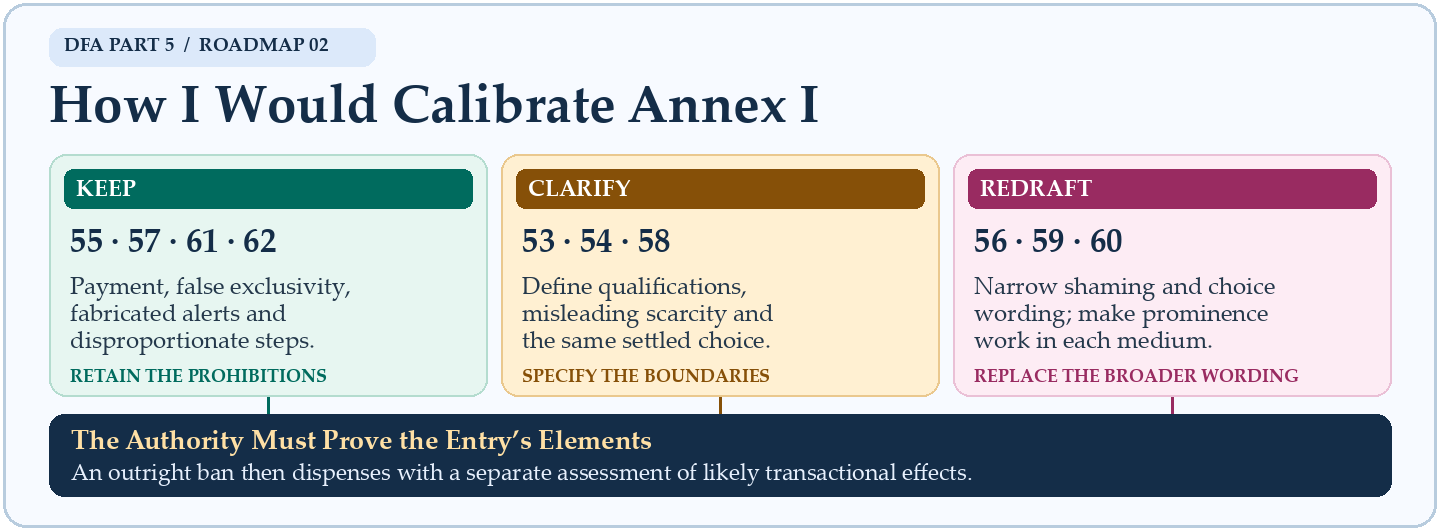
In Part 3, I labelled entries Keep, Clarify or Redraft. Articles 5(5) and 10(2) dispense with a separate effects inquiry once the authority establishes an entry’s elements. Precision must therefore sit inside the prohibition.6
I would keep points 55, 57, 61 and 62: inferred agreement to additional or substituted purchases, false exclusivity, fabricated alerts and disproportionate refusal or withdrawal steps. For point 62, guidance should assess the whole burden, including waiting and transfers. Account security can justify authentication; it cannot automatically justify routing an already authenticated subscriber through retention offers.7
Point 53 should require qualifications necessary to prevent an availability or popularity claim from conveying a false impression. Point 54 should assess whether repeated statements, viewed together, create a misleading impression of scarcity. That deliberately leaves pressure from truthful repetition to the general test unless legislators define a narrower abuse for the blacklist.8
Point 58 should aggregate requests across channels where the trader controls their coordination and seeks reversal of the same settled choice. A materially different offer can present a new decision. Rephrasing the original offer or moving it into email cannot, by itself, reset the assessment. Preserve the exception for requests necessary to comply with law.9
Point 56 needs a narrower prohibition on refusal options that attribute a derogatory personal characteristic to consumers who decline, or misrepresent the consequences of declining. Truthful explanations of lost access must remain possible. Less clearly defined emotional pressure belongs under the general rules unless the legislature can specify the abuse more closely.10
For point 59, I would prohibit choice labels whose ordinary meaning for the relevant audience misrepresents the action or consequence, including a reversal between label and operation. Mere linguistic imperfection should not establish a per se infringement. Other ambiguity remains assessable under Article 7.11
Point 60 should require price, duration and renewal information to be readily perceptible and intelligible within the invitation to purchase, before the consumer acts. Guidance should address the relevant medium, including speech. A requirement that every disclosure match every other disclosure’s prominence invites visual clutter and supplies little guidance for audio.12
Article 10(3) also needs substantive criteria for future additions. The Commission should explain why an entry can define the abuse sufficiently precisely to dispense with separate proof of distortion and publish the supporting evidence. Article 37 already provides scrutiny; Article 290 TFEU reserves essential legislative choices to the legislature.13
Require Enough Records to Reconstruct the Practice
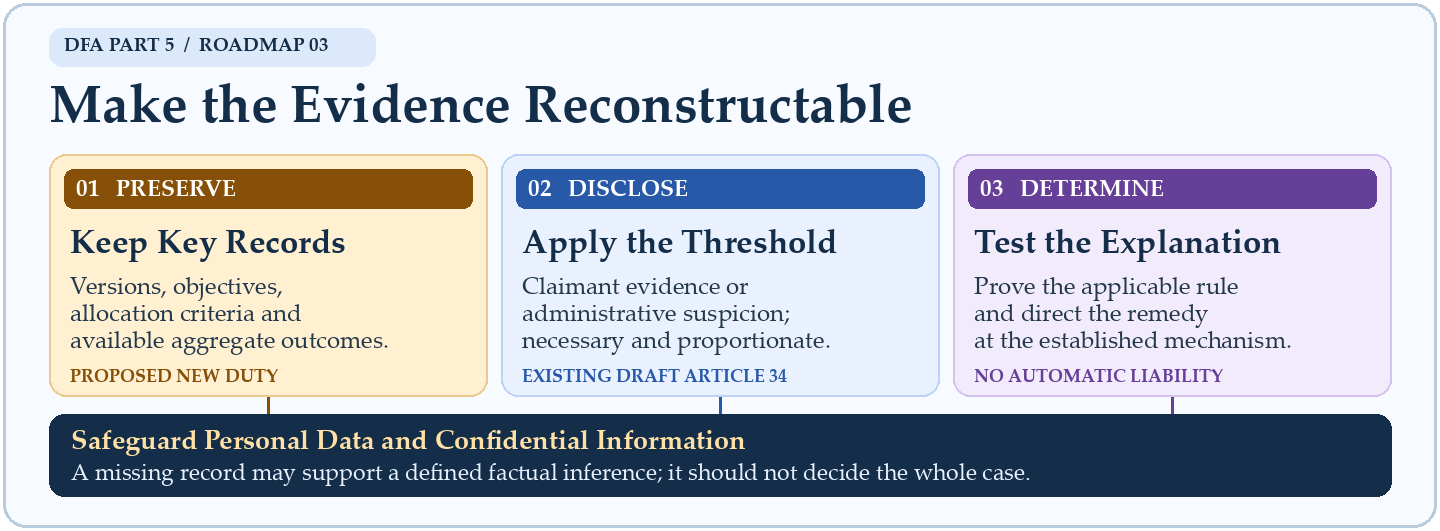
Recital 85 recognises the trader’s evidential advantage. Article 34 permits conditional disclosure in proceedings under Articles 30 and 32. A claimant must present facts and evidence supporting the likelihood of an unfair online practice; an administrative authority must reasonably suspect one. Disclosure remains necessary and proportionate. The missing obligation concerns preservation before proceedings begin.14
I would add a duty along these lines:
Traders that materially vary online commercial practices through automated selection or experimentation shall preserve records sufficient to reconstruct variations affecting price, contracting, refusal, termination or the exercise of consumer rights. Records shall identify the versions deployed, the objectives and allocation criteria, and available aggregate outcomes. The extent and duration of preservation shall reflect the risks to consumer decisions, scale, complexity and reasonable investigatory needs.
The legislature should specify retention periods for defined risk categories, with a bounded preservation power once an investigation becomes foreseeable. Documentation should permit reconstruction of an allocation rule without retaining every model state or interaction. Indiscriminate retention creates unnecessary cost and privacy exposure.
The obligation should reach records within the trader’s possession or control, including records obtainable from a contracted experimentation provider. Supplier contracts should secure access. Disclosure should protect trade secrets while supplying intelligible explanations. GDPR data minimisation and storage limitation require defined purposes and duration. Aggregate records should be the starting point, with safeguards against reidentification; aggregation does not guarantee anonymity.15
Article 34(5) already permits authorities to weigh non-disclosure alongside other evidence. I would supplement it with a narrow rebuttable presumption: unjustified failure to preserve required records may support an inference about a specifically alleged extra step or repeated prompt where the claimant has supplied credible evidence of it. The inference should address the disputed fact. It should not automatically establish material distortion, causation of loss or liability for compensation. Any use in punitive proceedings requires the applicable procedural guarantees.16
Make Cooperation Produce a Coherent Remedy
Article 4 addresses conflicts with other Union legislation. Article 30 goes further: paragraphs 5–7 allocate supervision for specified provisions through DSA and AI Act arrangements, while paragraph 8 prevents certain national decisions from contradicting Commission decisions. The proposal therefore contains institutional machinery. It still needs a general procedure for a single practice that engages several regimes.17
I would require authorities to identify a coordinator, agree an investigation plan and maintain a shared evidence file under express rules on access, confidentiality and lawful data exchange. Each authority retains its statutory competence and decision-making responsibility. A timetable for resolving disagreement should prevent coordination from postponing enforcement. Urgent protective action remains available.
That procedure must respect substantive boundaries. DSA Article 25(2) excludes practices covered by the UCPD or GDPR from its own interface prohibition. Adjacent duties can nevertheless arise from the same journey. A consumer authority’s cancellation remedy cannot settle the lawfulness of processing personal data, and a valid consent mechanism cannot excuse an obstructed contractual exit.18
The remedy should address the mechanism the evidence establishes. If an allocation rule imposes unjustified transfers, removing a button label will achieve little. If the evidence instead shows informed acceptance of a genuine discount, lower cancellation rates cannot alone justify banning the offer. Authorities should examine whether the revised journey permits effective refusal and whether the trader has displaced the obstruction elsewhere. Article 29’s anti-circumvention rule already assists where conduct undermines a Chapter III obligation.19
Article 17 deserves the same discipline. Its controls for specified features can assist consumers, but “excessive use” needs a clearer connection to impaired control and the protected interest. An engagement metric alone cannot establish that impairment. The legislature should require evidence about the mechanism and its effects before extending controls through delegated acts.20
These amendments leave room for recommendations, genuine offers and accessible defaults. They also give authorities a workable response when a trader uses personalisation to frustrate a decision. Returning to the two subscribers, the authority could reconstruct the allocation, test the reason for the extra burden and apply the relevant prohibition. The trader could explain a necessary security check or demonstrate informed acceptance. Where the evidence establishes obstruction, the remedy could remove the routing that produced it. That is the standard against which I would judge the DFA.
References
- European Commission, leaked Proposal for a Digital Fairness Act, COM(2026) 1100 (standalone proposal), art 38, and accompanying Annex I. Recitals 52 and 85 in this text correspond to recitals 53 and 86 in the version examined earlier in the series. ↩
- Mark Leiser, Dark Patterns, Deceptive Design, and the Law (Hart 2025); EESC expert hearing intervention, 9 September 2026. ↩
- Leaked DFA, arts 20, 23, pp 58–61. ↩
- Leaked DFA, arts 3(3), (7), (11), pp 47–48; 10(1), p 55; recital 52, p 25. Page references use printed numbering. ↩
- Leaked DFA, art 5(2)(b)–(3), p 51. ↩
- Leaked DFA, arts 5(5), 10(2), pp 51, 55. ↩
- Leaked Annex I, Part III, points 55, 57, 61–62, pp 4–5. ↩
- Leaked Annex I, points 53–54, p 4. ↩
- Leaked Annex I, point 58, p 4. ↩
- Leaked Annex I, point 56, p 4. ↩
- Leaked Annex I, point 59, p 5; DFA, art 7(1)–(3), p 53. ↩
- Leaked Annex I, point 60, p 5. ↩
- Leaked DFA, arts 10(3), 37, pp 55, 69–70; TFEU, art 290(1). Article 290 ↩
- Leaked DFA, recital 85, p 35; art 34(1)–(3), pp 67–68. ↩
- GDPR, art 5(1)(c), (e); leaked DFA, art 34(3), p 68. GDPR ↩
- Leaked DFA, art 34(5), p 68. The preservation presumption is my proposal. ↩
- Leaked DFA, arts 4, 30(5)–(8), pp 50, 66–67. ↩
- Digital Services Act, art 25(2). DSA ↩
- Leaked DFA, arts 23, 29, 30(2), pp 60, 64–65. ↩
- Leaked DFA, art 17(1)–(2), pp 57–58. ↩
Originally published on LawBhoy on Substack on 16 November 2026. This article addresses the legislative texts available at that date.