
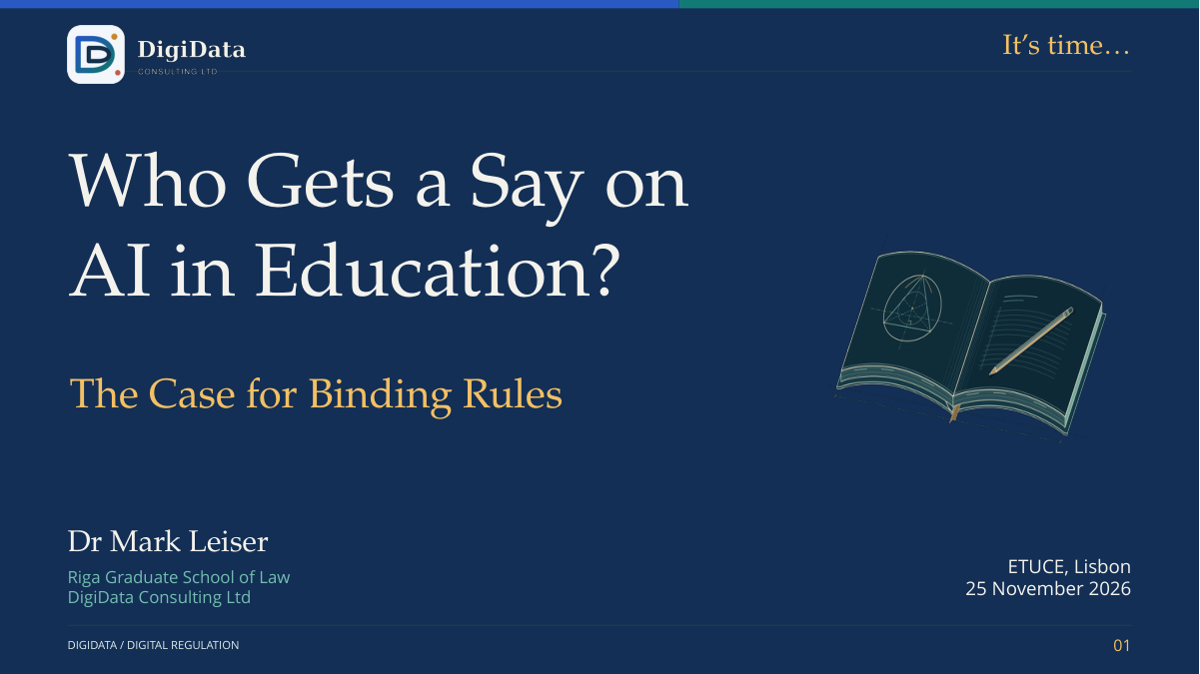
Presentation at the ETUCE Balancing AI Conference, Lisbon, 25 November 2026, for the session Governing AI for Quality Education.
Who can challenge the loss of a reading group when a school adopts an AI tutor? The presentation follows Leila, a fictional learner, through a procurement decision, a classroom pilot and a proposed change to her placement. It examines the opportunities pupils need to reason and deliberate, the authority teachers need to exercise professional judgement, and the influence staff representatives should have before a school commits to a tool or timetable.
Dr M.R. Leiser (Mark) proposes a binding minimum for quality education and agency. The slides distinguish that proposal from existing law and from the recommendation and code options under consideration. They organise the proposed instrument into eighteen articles.
The Proposed Instrument
- Articles 1–5: Scope and Responsibility. Educational purpose, implementation, institutional responsibility and shared technical assurance.
- Articles 6–8: Learner Agency. Proportionality, independent reasoning, children’s participation and equal access.
- Articles 9–11: Professional Judgement. Educational suitability, review before consequential decisions and participation by affected groups.
- Articles 12–15: Data, Contracts and Remedies. Learner work, supplier duties, continuity, monitoring and an effective route to challenge decisions.
- Articles 16–18: Oversight and Support. Impartial enforcement, expertise and staff time, cooperation and review.
The closing discussion asks which decisions educators should have the power to change and what unions could secure before schools sign contracts or set timetables.